
 Husbands are called to submit to their wives just as certainly as wives are called to submit to their husbands. What might this look like in a marriage?
There are many ways this can be implemented. One way is the impact it has on the decision-making process. For example, some couples take turns making decisions. Others make every decision together, talking it out until they agree on what to do. One method is to have the partner who is more knowledgeable in that area make the decision. Another possibility would be for the partner who feels more passionate on that issue to decide. My wife and I have used every one of these methods. The key is to build and maintain unity in the marriage, to honor one another, and foster equality and mutuality.
 This is one of the take-aways of Ephesians 5:21, where the apostle writes, “Submit to one another in reverence for Christ.” It seems to me that “in reverence for Christ” is a reference to the Imago Dei, the Image of God in both husband and wife. We are to submit to each other and honor each other because both husband and wife are made in the Image of God.
Another way mutual submission might show up in marriage is the way you balance two careers. We discovered early on that a wife’s career is just as important as a husband’s. We also realized that it’s sometimes difficult for both to get good jobs in the same area at the same time. Because of this, my wife and I have taken turns making professional sacrifices in order to further the other’s career.
A few years ago, I was pastoring a good church when my wife had an opportunity to join the faculty at a university that was a bit too far to commute. After discussing it, praying about it, and thinking it through, I decided to resign from the ministry position in order for her to take the teaching job. A lot of people criticized me for doing that, because they believed the husband and his career mattered, and the wife and her interests should always be subservient or marginalized. A few months after we moved, the Lord opened the doors to another ministry opportunity for me. Linda found fulfillment in her career, and so did I.
Ten years later, I had a chance to go into the Army as an Active Duty Chaplain. Knowing how much that meant to me, Linda willingly resigned from the teaching position that she loved, in order to facilitate my dream of being a military chaplain. It just so happened, that my first duty station was near a university that had a PhD program in her field. She applied and was accepted.
As she was completing her degree, she got a new job that wouldn’t have been possible had she not completed the doctorate. Again, one of us submitted so the other could pursue a career opportunity. Every time we did that, it worked out to the benefit of the one who was making the sacrifice, and we were both able to pursue our dreams.
If you want to read more about this, take a look at WisdomBuilt Biblical Principles of Marriage.

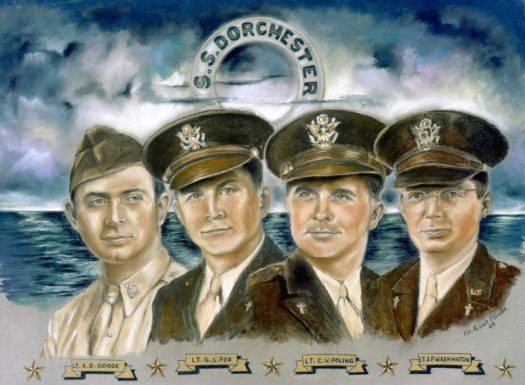
 Fifty-five minutes past midnight on February 3, 1943 the USS Dorchester was on its way to Greenland with more than nine hundred men on board. Captain Hans Danielsen, aware that German U-boats were in the area, had ordered the men to stay ready and keep their life jackets on, but many of them disobeyed the order because the life jackets were uncomfortable and impossible to sleep in.
 Two hundred thirty men made it into the rescue boats that night. As they looked back at the sinking ship, they saw the four chaplains standing on deck, arms linked, praying and singing in Hebrew, Latin, and English.
 Paul Linzey