
After the symphony came to a crescendo and the program concluded, the visiting violin soloist took a bow, received her bouquet of roses, and approached the microphone.
“Thank you, ladies and gentlemen. Thank you so much for your kindness. Thank you for being here tonight. It is an honor to accompany your symphony orchestra for this performance. And one more thing. I want to thank Ms. Alberta Carter for being here. Today is Ms. Alberta’s one hundredth birthday. Happy birthday, Alberta!”
The audience broke into another round of applause, and as they headed towards the exits, a reporter approached Ms. Carter.
“Ms. Carter, may I ask a question or two?”
“Certainly. What do you want to know?”
“I am covering this event on behalf of the local television station. How do you know Samantha, the guest violinist?”
“Do you mind if I sit down to tell you the story?”
“Not at all. In fact, I will sit down, too. If you don’t mind.”
“How do I know Samantha?”
– – – – – – – – – –
Every Sunday afternoon, seven students from downtown Alexandria’s River’s Edge School of Music arrived at 1:45 to set up for their music session at the George Washington Center for the Aged, otherwise known as “the old folks home.” Nobody knew for sure when the retirement home was built. The building itself was so run down that the musicians joked it had probably been there since George Washington himself was an old man.
They had been coming every Sunday, rain or shine, since the music school was formed in 1997. Of course, the members of the group changed every year as some graduated from the program and new students enrolled. But the woman in charge of community service at the school always made sure there were seven musicians ready to play and talk and smile every Sunday afternoon.
The combo always had at least one guitarist, pianist, and drummer. And depending on the participants in a given year, the instruments might include a flute or clarinet, a trumpet or trombone, and in good years, a violin and cello.
The residents enjoyed their Sunday afternoon concerts. They liked seeing the young people. They loved having something to alleviate the boredom. They craved the human connection to the outside world. But what meant the most to them was the affection offered by the instrumentalists.
“The Kids” would smile and talk with them. They often offered a hug or a pat on the back, and being touched by someone other than a medical professional was rare these days. Whenever the topic of conversation got around to family, the consensus among the residents was that after the first year in the home, most of their relatives and friends stopped visiting. All they had to look forward to were the weekly worship service led by the community church, the sabbath service conducted by the local synagogue, and the music program.
“Who’s that? A new violinist?” ninety-one-year-old Margaret asked eighty-nine-year-old Alberta.
“I think so,” Alberta replied. “I haven’t seen her before.”
“She looks too young to be at the music school, doesn’t she?”
“They get younger every year, Margaret.”
“You’re right about that!”
“But she looks so sad.” Alberta made this observation softly, and Margaret didn’t make out all the words.
“What did you say?”
“I said she looks so sad.”
“Oh dear. You’re right about that, too!”
“Margaret, do you have any note paper with you?”
“No, dear. But I can ask the receptionist if he does.”
Margaret excused herself from the program and shuffled out of the room and down the hall to the entrance of the facility.
“Young man? Might you be able to loan me some paper?”
“Of course, Ms. Margaret. How much would you like?”
“Oh, perhaps two sheets, an envelope, and a pen? Would that be all right?”
“Yes ma’am. Here you go.”
After the receptionist handed her the stationery from the George Washington Center for the Aged, and included the pen and envelope, Margaret made her way back to the music room and sat down next to her friend.
“What are you going to do, Alberta?”
“I want to write her a note and invite her to come visit us sometime, if she ever wants to talk. Who knows? She might want to.”
“That’s a lovely idea. You never know.”
Alberta wrote the note, included her own name and room number, and asked one of the nurses if she would hand it to the young violinist after the next song.
“Of course, Ms. Alberta. I’d be happy to do that for you. But you know our policies. I’ll have to open it and read it first.”
“I know. That’s why I didn’t seal it.”
The nurse read the note, sealed it, and after the next song, she walked over and gave it to the young girl. She looked at the envelope, then up at the nurse, who pointed over to where Alberta and Margaret were sitting. Alberta waved and smiled.
When the concert was over, the musicians packed up their instruments and took about thirty minutes to talk with the residents. The violinist approached Alberta.
“Hello. My name is Samantha.”
As Alberta started to introduce herself and her friend to Samantha, the young girl started to cry, then turned and ran down the hall, her violin in one hand, the envelope in the other.
Four days later, before Alberta started getting ready for supper, there was a knock on her door.
“Ms. Alberta?” knock, knock, knock. “Ms. Alberta?” knock, knock, knock. “You have a visitor.” The nurse shouted to make sure she was heard.
Alberta opened the door and immediately recognized Samantha.
“Come in! Come in! I am so glad to see you!”
“Hello. My name is Samantha.”
“Yes, I remember, Samantha.”
“I was so surprised when the nurse handed me your note last Sunday. You see, I am brand new to the music school, and I wasn’t expecting that.”
“That was the first time I have written a note to one of the student musicians. But I saw you and noticed three things about you. One, you are a very good violinist. Two, you are very pretty. And three, you seemed so sad. I hope you don’t mind my saying so. I don’t mean to offend you.”
“No, not at all, Ms. Alberta. I was hoping that nobody would notice how sad I was, but I do need someone to talk with, and after reading your note and seeing you wave to me, I wondered if . . .”
“What is it, Samantha?”
“I wondered if I could come and visit you once in a while.”
“I would like that.”
“I come from a small town, not far from here. A week after I was accepted into the music school, my family died in a car crash. Hit by a drunk driver. My mom and dad and little brother were on their way to my last high school concert. They never got there.”
Alberta reached out and placed a hand on Samantha’s wrist. Samantha stopped talking long enough to shed a few tears, wipe her eyes, and then continue.
“My parents almost always sat in the same place. But I just assumed they got there a little late and had to sit farther back. I didn’t find out what happened to them until after the program ended.”
“Oh, Samantha. I’m so sorry.”
“I have no other family. Nobody who wants me, anyway. My grandparents are dead. My aunt doesn’t have time for me. Or interest, for that matter. And when I read your note, well, for the past few days, I wondered if you might be willing to be my family. I’m not asking for money or anything. I just, I just need someone I can talk to once in a while.”
“Samantha, I would be delighted to be your family. It would be an honor.”
For the next four years, Samantha visited Alberta once a week, in addition to participating in the Sunday events, and they became quite close. After Samantha graduated and turned professional, Alberta followed her career, sending her a card or flowers from time to time. And whenever Samantha returned to the area, she visited Alberta at the George Washington Center for the Aged.
– – – – – – – – – –
“Wait a minute!” the reporter gasped. “Are you Alberta Carter who used to be first violinist of this very symphony?” “Yes, I am,” the centenarian replied. “More importantly, Samantha and I are family.”
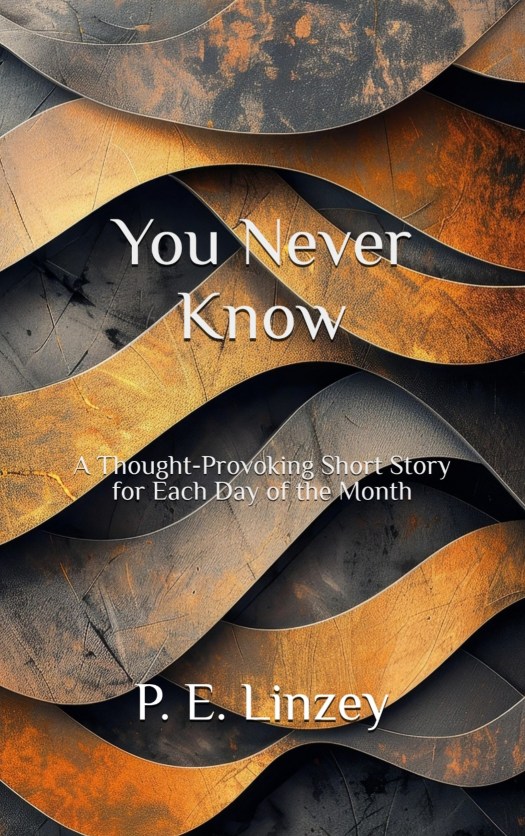
This is the second story in the collection, providing the title for the book. It is available on Amazon. Most of the stories are shorter than this one.

 Paul Linzey