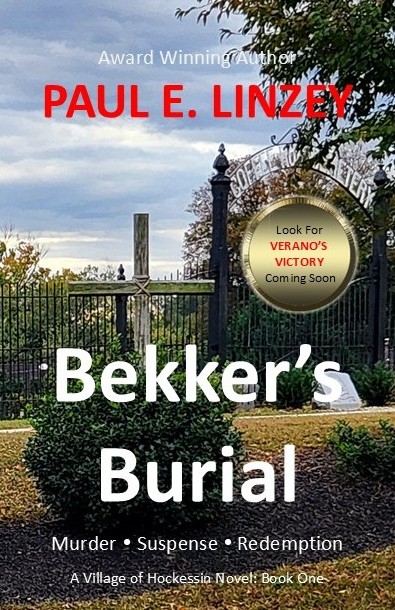
Bekker’s Burial Opening Scene

Corporate attorney Madison Bekker and her husband, NBA star John Verano, are in a miserable marriage. While he’s getting ready for a road trip to start the new season, he hears the words no man ever wants to hear from his wife or girlfriend. He doesn’t want the distraction of a serious discussion, which would obviously not go well, so he puts her off again. He promises to have that discussion when he returns, but she’s angry and doesn’t believe him. She’s getting ready for a conference in Denver. Their conversation ends with both wondering whether they’ll ever be happy. There’s got to be more to life and love and marriage than this.

And then the action begins. Murder, theft, kidnapping, intrigue, discovery, and more.

Bekker’s burial is a cross-country & international journey in search of identity, happiness, and meaning. Full of action, intrigue, and danger, it includes themes of trust, envy, and love.

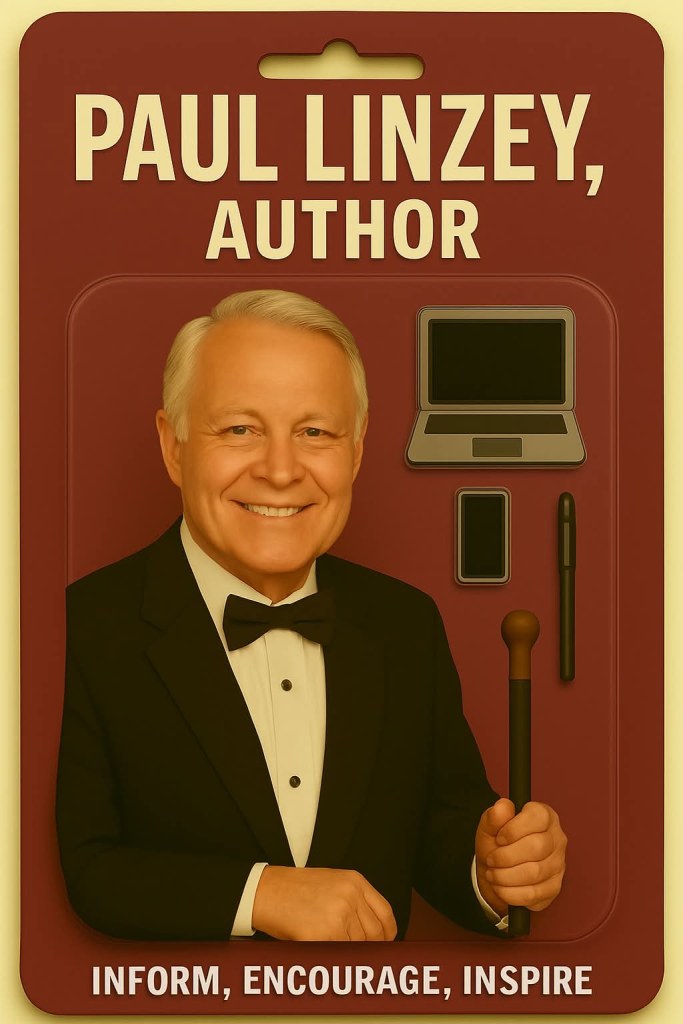
Paul Linzey is the award winning author of more than ten books and contributor or editor of several more.

Debut Novel by Paul Linzey

Bekker’s Burial is a combination of domestic thriller, suspense, action mystery, and historical fiction. The 84,000 word manuscript is available online at Amazon, the author’s website, and many other booksellers.

A contemporary faith based Contemporary Fiction novel that starts in Walnut Creek, moves to Wilmington, and finishes in Amsterdam, the story is a search for happiness, identity, and meaning. Madison is a Dutch American who inherited a box of books and papers from her father. She follows the clues and discovers her family’s heritage in seventeenth century America. John is a Mexican American whose brother joins in searching for the MacGuffin . . . whatever it is.

Madison Bekker is a corporate lawyer and her husband, John Verano, is a former NBA player and now a college coach. They are on the verge of divorce when her parents are murdered, he is severely injured, and they both lose their jobs. They move from Northern California Bay Area to Suburban Delaware to get a fresh start in careers and marriage, but soon find themselves fighting for their lives.       

A series of events including coercion, threats, violence, invasion of privacy, and kidnapping leads to a discovery that may be worth millions—if they find it first, if they’re not killed, and if their marriage survives. The FBI and the local police are looking for whoever is plotting and killing in Europe and America in order to inherit the massive Bekker fortune.

The story is comparable to We Don’t Talk About Carol (Kristen L. Berry, 2025) in terms of discovering family identity and secrets, a struggle with trust and happiness, as well as the process of making sense of one’s place in the world. It resembles Hidden in Plain Sight (Jeffrey Archer, 2020) in its simple linear writing style and a plot that includes personal struggles mixed with professional lives. And there’s a similarity with Camino Island (John Grisham, 2017) in terms of a search for lost historical documents, trying to get a fresh start in life, and showing character through their actions. There are similarities with Terri Blackstock and J. Sydney Jones.

After completing an MFA in Creative Writing at the University of Tampa, I’ve written six nonfiction books, and contributed to several others. In 2019, I won two first-place writing awards for a memoir titled Safest Place in Iraq: a Gold from the Florida Writers Association’s Royal Palms Literary Awards in the Memoir category, and a First Place Peach Award from the North Georgia Christian Writers Conference in the Bible Studies and Nonfiction category. Two of my nonfiction books are being used as textbooks in several colleges and seminaries.

I participated in Writer’s Digest’s February Flash Fiction Challenge this year and self-published those stories. Bekker’s Burial is my first full-length fictional work.

Historical Vignette

Four Hundred Years Ago

In 1602, the Government of the Netherlands chartered the Dutch East India Company to protect trade in the Indian Ocean and assist in the Dutch war of independence from Spain. Seven years later, they hired Englishman Henry Hudson to look for a Northwest Passage, a hoped-for shortcut to the Pacific Ocean. He sailed into Delaware Bay and then up to what is now the Hudson River and claimed the New World for the Netherlands. The first Dutch settlers arrived five years later.

The Dutch West India Company began in 1621, primarily to conduct economic warfare against Spain and Portugal by attacking their colonies in the West Indies, South America, and the west coast of Africa. The Company was granted a monopoly of the trade with the Americas, Africa, and everything between. As the leader of the colony, a German merchant named Peter Minuit purchased Manhattan Island from the indigenous Lenape people in 1624 and named it New Amsterdam. The entire region was named New Netherlands, and consisted of what is now western Connecticut, southeastern New York, all of New Jersey, and the eastern edge of Delaware.

Control of Delaware took a sharp turn in 1638 when a Swedish expedition, led by the same Peter Minuit, arrived and built Fort Cristina. The Dutch governor in New Amsterdam protested, but Minuit ignored him because New Amsterdam had no military presence in Delaware. It wasn’t until 1655 that the Dutch regained control. They gave Fort Christina a new name, Fort Casimir, and a year later the area was officially renamed New Amstel.

By 1664, the British had conquered the entire region and changed the name of Fort Casimir to New Castle. England would rule the colonies for the next hundred years. In 1739, the name changed again, this time to Wilmington.

At first, most of the population in Northern Delaware remained near the coast. They would go inland to hunt or to trade with the Lenape, but very few Europeans lived upstream from Fort Cristina/Fort Casimir/New Amstel/New Castle/Wilmington. Gradually, they moved up-river and up-stream, creating farms, mills, and villages.

The streams, creeks, and rivers west of Wilmington were crucial to the development of the area because before there was gas, steam, or electrical energy, it was the power of water that was harnessed for industry. The region was known for its sawmills, paper mills, flour mills, gristmills, oil mills, and cider mills. One of the main streams was ten-mile-long Mill Creek, which is why the area became known as Mill Creek Hundred. One of the towns that formed on the banks of Mill Creek is known to this day as The Village of Hockessin.

In 1777, the British Army, led by Cornwallis, marched his Redcoats north from Newark, Delaware, on their way towards Philadelphia. They destroyed farms, homes, businesses, and mills. They burned crops, slaughtered livestock, and murdered everyone who they deemed to be disloyal to the English Crown.

Some of the people tried to defend their land. Many abandoned their homes in order to survive. A few of them buried their possessions, hoping to return after the war to rebuild their lives, their homes, and their towns.

How is this real-world historical vignette relevant and why does it matter? You are about to find out when you read my debut novel, Bekker’s Burial, available on February 21, 2026 both as an ebook and a paperback.

God Loved What?

John 3:16 has long been considered to be one of the most important statements in the Bible. Kids have been encouraged to memorize it in Sunday school. Preachers have expounded on it for centuries. Missionaries have gone to the far reaches of the planet to tell people about it. And football fans have created large signs to hold up for the cameras during televised games.

“God so loved the world,” it says. But who or what is it talking about?

“World” in this verse is the Greek word “cosmos” and in Classical Greek, it had to do with order, arrangement, or adornment. In the New Testament, it may be a reference to the universe or to our planet. A second possible meaning has to do with the corruption that we see in the world. And a third definition refers to the people who live on this planet. Human beings.

This is what the writer of the gospel had in mind when he wrote “God Loved the World.” Very clearly, he is saying God loves people. Not some people . . . all people. He doesn’t love some people more than others. He loves all people equally. There are other statements in the New Testament that quite explicitly tell us God doesn’t practice favoritism.

God loves everyone.

At the very end of the Gospel of Matthew, Jesus tells his disciples to take this message to all the nations. To all the “nations”? This is a different word, but the meaning has an interesting overlap with “world.” Nations in the Greek is the word “ethnos” and really means “people groups.” It’s where we get the words “ethnic” and “ethnicity.”

God loves people. Everyone. All people groups. No matter what language we speak. Regardless of the tone of our skin. No gender more than another. It doesn’t matter who our parents are or were or where we came from. God loves people.

What this means to me is that anyone who claims to be a follower of God should adopt his values because in a certain sense, we represent him to the world. And if we’re not in the habit of loving people, we’re not doing a very good job representing the God who is Love.

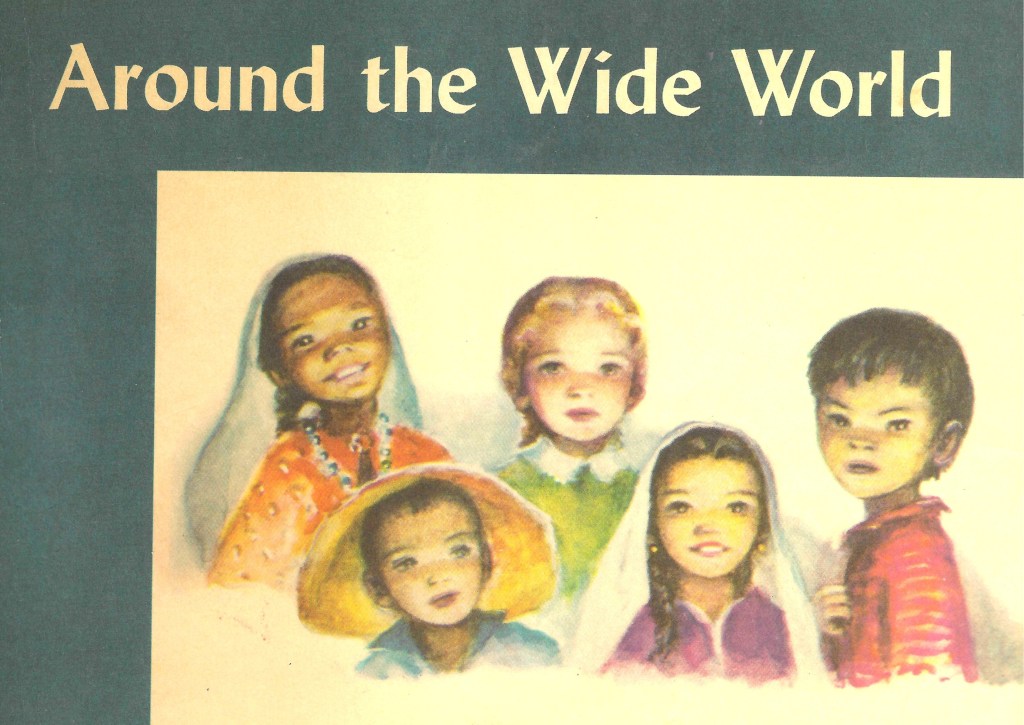
The picture below is the cover of a booklet my wife received when she was a young girl in Vallejo, California. She started attending Sunday School at a nearby Presbyterian church and was given this collection of stories from around the world. Published by the Westminster Press in 1956, and written by W. L. Jenkins.