Do You Need a Mentor?

One of the ways to avoid getting into trouble is to establish accountability measures and allow key people in your life to hold you answerable for what is morally right and what is helpful in your career. It is important to establish professional and spiritual mentoring relationships. We all need someone we can turn to when we are tempted, when we’re hurting, and when we’re about to do something unwise.

When I became a chaplain and went to the Officer Basic Course, Ron Casteel was the class leader. He and I became friends and kept in touch throughout our careers. Not only was he a friend, he became my mentor. Ron knew more than I did about how the military worked. He understood people. And several times when I needed guidance, he was there for me.

Fourteen years after completing the basic course, I had the opportunity to work for him at a senior command. Not only was he my friend and mentor. Now he was my boss. It was a great experience. After he retired, there was one more time that I needed his help professionally, and he was there for me. Having him as a mentor made a powerful impact on my life and career.

Perhaps you should consider finding a mentor. In fact, you might want to identify two mentors: one for spiritual accountability, and one for professional development. Allow key people in your life to hold you answerable for what is morally right, and what is helpful in your career. And listen when they speak or offer guidance.

Wherever you are in your career, it may be important for your growth, development, and success to find one or two people who can speak into your life as a friend and mentor.

Driving Up the Mountain

I was a chaplain with an infantry battalion that was conducting field exercises in Yakima, Washington. While visiting our soldiers at remote locations, I asked my Chaplain Assistant if he would go up and over the mountain instead of taking the road around it. He agreed, but soon stopped and said he couldn’t go further because it was too steep. I told him the Hummer was built for steep inclines and asked him to proceed.

That’s when he said, “Chaplain, I’m not stopping because the vehicle can’t make it. I’m stopping because it’s too scary. I don’t want to drive up this mountain!”

“I understand. Let’s trade places and I’ll drive.”

Being a good, responsible NCO, he insisted that I show him my military driving license. And I did.

Driving up that mountain was so much fun. We got to the top, got out, and looked around. We could see for miles in each direction. Coming back down was even scarier because it seemed we were looking straight down. It was exhilarating. We were now ready to go and visit our Soldiers.

Funeral for a Clock

After I completed the Army Chaplain Basic Course, my first assignment was with a medical unit. While participating in a field training exercise at Camp Parks in California, I met with the First Sergeant one day, and he told me that one of his Soldiers died. When I asked who the soldier was, he told me the name of the guy was “Otto.”

Well, I knew Otto was the name of the alarm clock dressed in an Army uniform. Instead of a bugle playing Reveille first thing each morning, the First Sergeant held a microphone up to the clock to wake up the troops. When the alarm sounded, a Drill Sergeant voice shouted, “Rise and shine, you sleepyheads, Rise and shine!” Somebody got tired of hearing that stupid clock shout “Rise and Shine,” so he made a noose and strung up poor Otto between two field tents. There he was swinging in the breeze.

“What do you do when a Soldier dies?” the First Sergeant asked.

“I would do a funeral,” I answered matter-of-factly.

“Would you?” His eyes got real big.

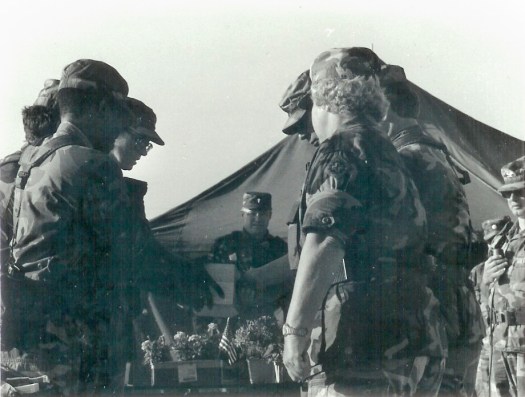
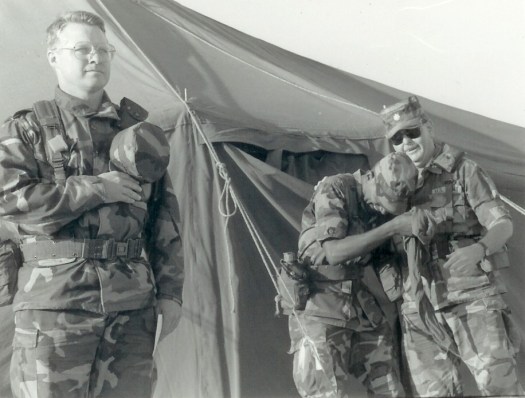
Two days later, still out in the field on the back side of an Army training base, we had a funeral complete with full military honors and protocol . . . for Otto the Clock. One of the Soldiers was a carpenter. He used scrap lumber to build a scale model replica of a coffin. Six Soldiers served as pall bearers, marching in step as they carried the coffin to the ritual. The Colonel gave the commander’s speech. The First Sergeant provided a tearful eulogy. And the Chaplain’s funeral sermon was a poem about time. Each of us is allotted a certain number of days, and when our time runs out, we’re called to give an account before the Great Clockmaker in the Sky.

A hundred Soldiers laughed so hard they literally fell out of formation onto their hands and knees in the dirt. Some of them pretended to howl and cry, others had actual tears because they were laughing so hard.

My college and seminary professors and ministerial textbooks didn’t cover funerals for clocks, and homiletics classes never trained me to write sermons as poems, but that event created a rapport with the Soldiers better than anything I could have planned. For the rest of my time with that unit, I had an open door of ministry.

Actual pictures of the funeral. Click here to read the poem.

Military Ministry: Chaplains in the 21st Century

I am excited to announce that our publisher just released the book Military Ministry: Chaplains in the Twenty-First Century, second edition.

When we started writing this book in 2020, we understood the importance of social media in ministry, so the first edition contained a dozen or so statements about social media, but there wasn’t a stand-alone chapter with a strategy for using social media or technology in ministry in the military. In the past five years, however, social media has explosively become much more pervasive, and in many ways has come to define the present generation. Therefore, it became obvious that we needed to provide an updated edition that would speak directly to this issue.

At a lunch meeting to discuss the preparation of a new chapter and what it should include, Dr. Keith Travis suggested that we ask Chaplain Chris Linzey if he would write the new chapter because Chris is on the cutting edge of using social media platforms for ministry in the United States Navy. Chris is an outstanding chaplain and a master at using new technologies in military ministry. We agreed that Chris would be the best person to write the new content. When we approached him with the idea, he responded right away with an affirmative reply. His original submission turned into two full chapters.

With that in mind, we are pleased to offer this second edition of Military Ministry: Chaplains in the Twenty-First Century. Chapters 26 and 27 are the brand-new chapters written by Chaplain Chris Linzey. In addition, there is a new Guest Anecdote from a chaplain who understands the use of social media in effective ministry. We think this material will be a tremendous benefit for chaplains in all of the armed forces.

It is our hope that you will be informed, encouraged, and inspired as you read this book. You are always invited to reach out to us by email, through our websites, social media, or the QR codes at the end of chapter 27. We’d love to hear your comments or reactions to the content in the book. May the Lord bless you as you serve as a chaplain in the military.

#MilitaryMinistry #MilitaryChaplainGuide #TrainingMilitaryChaplains

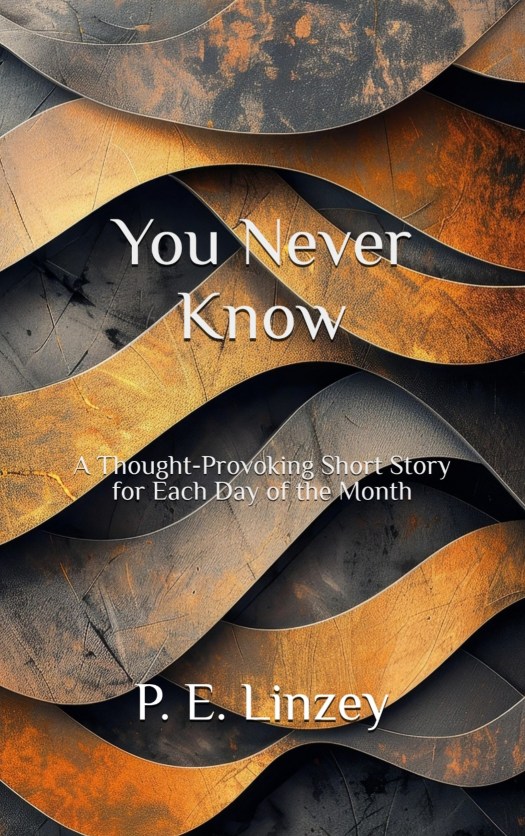
You Never Know

You Never Know is the author’s response to Writers Digest’s annual month-long challenge to write a piece of flash fiction every day for a month and is his initial entry into the world of writing fiction. The title of the collection comes from the first story.

A collection of thirty-one flash fiction short stories, each story is a thought-provoking snapshot that captures a different aspect of what it means to be human and elicits a wide range of emotional responses. By the way, flash fiction stories are typically no longer than 1,500 words and may be as short as the now-famous six-word stories, allegedly started by Ernest Hemingway.

Comments from early readers:

— Wow! Crazy. Great story.

— I was engaged immediately.

— Sharp, well-paced, with natural dialogue and engaging characters.

— Oh, gosh. That was a sad one.

— Nicely done. Authentic dialogue and a good story line.

— Well-written and realistically frightening.

— I was hooked.

— Could be the start of a television series.

— The ending really makes this special.

— I love this story. Great premise!

— That is hilarious!

— I’m laughing my head off!

— Very theological without even bringing up theology.

— The story took me back to my own experience.

— It really touched me.

— Amazing story of perseverance and love.

— Holy crap! I just read your story.

— What a story. It has a triple twist.

— You inspired me.

— Superb!

P. E. Linzey is an award-winning author who completed the Master of Fine Arts in Creative Writing at the University of Tampa with a dual emphasis in Fiction and Nonfiction. He uses his full name for nonfiction (Paul E. Linzey), and his first and middle initials for fiction (P.E. Linzey) as a way of differentiating.

He is a member of several writers associations, was a university Associate Professor of Creative Writing and Composition, and is a speaker at writers conferences, schools, churches, and other groups. You may see his full list of writings on his website: https://paullinzey.com/ and you are welcome to contact him using the Connect page.

You Never Know

After the symphony came to a crescendo and the program concluded, the visiting violin soloist took a bow, received her bouquet of roses, and approached the microphone.

“Thank you, ladies and gentlemen. Thank you so much for your kindness. Thank you for being here tonight. It is an honor to accompany your symphony orchestra for this performance. And one more thing. I want to thank Ms. Alberta Carter for being here. Today is Ms. Alberta’s one hundredth birthday. Happy birthday, Alberta!”

The audience broke into another round of applause, and as they headed towards the exits, a reporter approached Ms. Carter.

“Ms. Carter, may I ask a question or two?”

“Certainly. What do you want to know?”

“I am covering this event on behalf of the local television station. How do you know Samantha, the guest violinist?”

“Do you mind if I sit down to tell you the story?”

“Not at all. In fact, I will sit down, too. If you don’t mind.”

“How do I know Samantha?”

– – – – – – – – – –

Every Sunday afternoon, seven students from downtown Alexandria’s River’s Edge School of Music arrived at 1:45 to set up for their music session at the George Washington Center for the Aged, otherwise known as “the old folks home.” Nobody knew for sure when the retirement home was built. The building itself was so run down that the musicians joked it had probably been there since George Washington himself was an old man.

They had been coming every Sunday, rain or shine, since the music school was formed in 1997. Of course, the members of the group changed every year as some graduated from the program and new students enrolled. But the woman in charge of community service at the school always made sure there were seven musicians ready to play and talk and smile every Sunday afternoon.

The combo always had at least one guitarist, pianist, and drummer. And depending on the participants in a given year, the instruments might include a flute or clarinet, a trumpet or trombone, and in good years, a violin and cello.

The residents enjoyed their Sunday afternoon concerts. They liked seeing the young people. They loved having something to alleviate the boredom. They craved the human connection to the outside world. But what meant the most to them was the affection offered by the instrumentalists.

“The Kids” would smile and talk with them. They often offered a hug or a pat on the back, and being touched by someone other than a medical professional was rare these days. Whenever the topic of conversation got around to family, the consensus among the residents was that after the first year in the home, most of their relatives and friends stopped visiting. All they had to look forward to were the weekly worship service led by the community church, the sabbath service conducted by the local synagogue, and the music program.

“Who’s that? A new violinist?” ninety-one-year-old Margaret asked eighty-nine-year-old Alberta.

“I think so,” Alberta replied. “I haven’t seen her before.”

“She looks too young to be at the music school, doesn’t she?”

“They get younger every year, Margaret.”

“You’re right about that!”

“But she looks so sad.” Alberta made this observation softly, and Margaret didn’t make out all the words.

“What did you say?”

“I said she looks so sad.”

“Oh dear. You’re right about that, too!”

“Margaret, do you have any note paper with you?”

“No, dear. But I can ask the receptionist if he does.”

Margaret excused herself from the program and shuffled out of the room and down the hall to the entrance of the facility.

“Young man? Might you be able to loan me some paper?”

“Of course, Ms. Margaret. How much would you like?”

“Oh, perhaps two sheets, an envelope, and a pen? Would that be all right?”

“Yes ma’am. Here you go.”

After the receptionist handed her the stationery from the George Washington Center for the Aged, and included the pen and envelope, Margaret made her way back to the music room and sat down next to her friend.

“What are you going to do, Alberta?”

“I want to write her a note and invite her to come visit us sometime, if she ever wants to talk. Who knows? She might want to.”

“That’s a lovely idea. You never know.”

Alberta wrote the note, included her own name and room number, and asked one of the nurses if she would hand it to the young violinist after the next song.

“Of course, Ms. Alberta. I’d be happy to do that for you. But you know our policies. I’ll have to open it and read it first.”

“I know. That’s why I didn’t seal it.”

The nurse read the note, sealed it, and after the next song, she walked over and gave it to the young girl. She looked at the envelope, then up at the nurse, who pointed over to where Alberta and Margaret were sitting. Alberta waved and smiled.

When the concert was over, the musicians packed up their instruments and took about thirty minutes to talk with the residents. The violinist approached Alberta.

“Hello. My name is Samantha.”

As Alberta started to introduce herself and her friend to Samantha, the young girl started to cry, then turned and ran down the hall, her violin in one hand, the envelope in the other.

Four days later, before Alberta started getting ready for supper, there was a knock on her door.

“Ms. Alberta?” knock, knock, knock. “Ms. Alberta?” knock, knock, knock. “You have a visitor.” The nurse shouted to make sure she was heard.

Alberta opened the door and immediately recognized Samantha.

“Come in! Come in! I am so glad to see you!”

“Hello. My name is Samantha.”

“Yes, I remember, Samantha.”

“I was so surprised when the nurse handed me your note last Sunday. You see, I am brand new to the music school, and I wasn’t expecting that.”

“That was the first time I have written a note to one of the student musicians. But I saw you and noticed three things about you. One, you are a very good violinist. Two, you are very pretty. And three, you seemed so sad. I hope you don’t mind my saying so. I don’t mean to offend you.”

“No, not at all, Ms. Alberta. I was hoping that nobody would notice how sad I was, but I do need someone to talk with, and after reading your note and seeing you wave to me, I wondered if . . .”

“What is it, Samantha?”

“I wondered if I could come and visit you once in a while.”

“I would like that.”

“I come from a small town, not far from here. A week after I was accepted into the music school, my family died in a car crash. Hit by a drunk driver. My mom and dad and little brother were on their way to my last high school concert. They never got there.”

Alberta reached out and placed a hand on Samantha’s wrist. Samantha stopped talking long enough to shed a few tears, wipe her eyes, and then continue.

“My parents almost always sat in the same place. But I just assumed they got there a little late and had to sit farther back. I didn’t find out what happened to them until after the program ended.”

“Oh, Samantha. I’m so sorry.”

“I have no other family. Nobody who wants me, anyway. My grandparents are dead. My aunt doesn’t have time for me. Or interest, for that matter. And when I read your note, well, for the past few days, I wondered if you might be willing to be my family. I’m not asking for money or anything. I just, I just need someone I can talk to once in a while.”

“Samantha, I would be delighted to be your family. It would be an honor.”

For the next four years, Samantha visited Alberta once a week, in addition to participating in the Sunday events, and they became quite close. After Samantha graduated and turned professional, Alberta followed her career, sending her a card or flowers from time to time. And whenever Samantha returned to the area, she visited Alberta at the George Washington Center for the Aged.

– – – – – – – – – –

“Wait a minute!” the reporter gasped. “Are you Alberta Carter who used to be first violinist of this very symphony?” “Yes, I am,” the centenarian replied. “More importantly, Samantha and I are family.”

This is the second story in the collection, providing the title for the book. It is available on Amazon. Most of the stories are shorter than this one.

GOTCHA

Early in my military career, I showed up at a new infantry battalion one day and started meeting some of the guys. The Sergeant Major introduced himself and asked, “Hey Chaplain, do you have your Gotcha Cards?”

“No, Sergeant Major. I’ve never heard of a Gotcha Card, and don’t know what it is, so I’m pretty sure I don’t have one. What is it?”

“Our previous chaplain, every time he heard one of us cuss or swear or use the Lord’s name in vain would pull out a business card, but all it said in big bold letters was GOTCHA. So when the guys heard we were getting a new chaplain, they started wondering if you were going to be like the last one.”

“I bet you guys hated him.”

“Yes. We. Did.”

“Tell you what. I’m not planning on having any Gotcha Cards printed up, so you can relax. Cuss if you want. I’m just here to love you guys.”

Apparently, a bunch of Soldiers were listening to the conversation, because as soon as I made that last statement, a cheer erupted from around the corner.

“You’re gonna fit in fine here, Chaps. Nice to have you aboard.”

Over the next two years, I led more than 25 of those guys to faith in Christ, and I never once said, GOTCHA. Oh, they cussed, alright. But I figured it was the Holy Spirit’s job to reach them, and he does a pretty good job. I just had to do my part, which was love them and be consistent in setting an example of what a Christian is and does.

This is the opening story in my new book titled Gotcha.

Story Themes

Several years ago when we lived in Florida, a hurricane blew threw our town, leaving a path of destruction. While driving one day, I noticed a home that had been damaged, and the entire fence around yard had been literally blown away. I mean, it was just gone. What amazed me was although the fence was gone, the gate that had been in the middle of the fence was still there, standing alone, all by itself, still closed and latched to a post on each side, almost as if it were a monument. I pulled over to the side of the road and took a picture, but the image itself is still clear in my mind.

That was the idea I used for the first story in the collection titled You Never Know. Something as simple as a gate can become a symbol — a memorial — for what happened in a place, for the life that happened there, for the people whose lives were touched in some way. And that’s what these flash fiction stories are all about.

People, Life, Relationships, Pain

Laughter, Sorrow, Victory, Failure

Ambition, Uncertainty, Excitement, and Surprise

Dreams, Premonitions, the Unknown, and Death

How we think and feel about these concepts.

And how we experience them in our day-to-day lives.

Each story reveals a small aspect of what it means to be human. And in reading them, perhaps you’ll connect with something inside yourself, relate to other people, and find a measure of hope for your own circumstances.

Meet Some of the Characters

My first Flash Fiction collection, You Never Know, will be available on March 7 both as a print book and an ebook. Each story elicits an emotional response and leaves the reader with something to think about. I had fun writing these stories, and I think you’ll enjoy reading them. Would you like to meet some of the characters you’ll encounter? Okay, since you asked.

Janeesha is a young lady who has to make a career decision. Molly loved her husband, Freddy, through thirty-one years of failure. The clown always wanted to be an accountant. Sam, the Golden Retriever, who was the loyalest friend a man ever had. George had a nickname for everyone: those he liked as well as those he didn’t. Samantha was a violinist whose family didn’t show up for her concert.

These and many other characters fill the stories with pain, joy, sorrow, and surprise.