
Ministry Follows Friendship

In 1986, Blue Diamond Growers in California initiated an ad campaign asking shoppers to buy a can of almonds each week. This was based on the fact that one almond tree produces fifty-two cans of almonds per year, and there are exactly fifty-two weeks in a year. Their slogan? “A can a week, that’s all we ask.” You can still find the old commercials on YouTube.

When I told my wife during a phone call that someone at Camp Echo was coming to faith in Christ every week, she recalled the TV commercial from years earlier and said, “A soul a week, that’s all we ask.” Being from California, I understood the allusion right away.

Linda had been praying that every week, someone would come to faith in Christ, and it was happening: someone at church on Sunday, a visitor to my office during the week, or a soldier in a unit training area. She prayed for the people I was ministering to, and God answered her prayers: a soul a week.

When I was a rookie chaplain, my supervisor showed up one day to mentor me. “Here’s my philosophy of serving as a military chaplain: ministry follows friendship. If you love your soldiers and spend time with them and they know you like them, then they’ll come to you when they want to talk about their spiritual need. Just love them, spend time with them, and trust the Holy Spirit to draw them. When they are ready to talk about the Lord, they’ll know who to go to.”

That sounded pretty good to me, so I adopted his philosophy of chaplain ministry. It was an effective approach throughout my military career, and it was true in Iraq.

Laughin’ and Prayin’

One Tuesday morning a big ol’ boy stepped into my office, and entered the Kingdom of God. He walked in unannounced. “Mind if I drop my body armor, chaplain?” It was already hitting the floor before I had a chance to reply.

“Not at all. Be my guest. Where are you from?”

“I’m from Brevard, North Carolina.”

“Brevard? I’ve been to Brevard.”

“Pity you,” he laughed loud at his own joke. “What were you doin’ in my town?”

“A friend of mine lives there. I was passing through and stopped to visit for a couple hours. Now, what are you doin’ in my office?”

“I grew up in church, but never got serious ‘bout Jesus or nuthin.’ Just out o’ boot camp an’ AIT, an’ they send me here. So, I figure if I’m gonna die right here in the desert at the ripe ol’ age of 19, might as well get saved, confess my sins, whole nine yards, make things right, ya know.”

I don’t think I’ve ever had as much fun praying with someone as I did with him that day. Six feet four, a muscular 225-pounder with short brown hair and medium brown eyes. He walked loud, talked loud, and lived loud. I imagine he even sinned loud.

“Hey! I even know what to pray,” he grinned.

“OK, you go first, then I’ll pray.”

“Gotcha!”

He was right; he knew what to do, and he prayed a great prayer. I don’t recall ever hearing someone telling God jokes during a confessional prayer, but he did. We both started laughing. He kept on praying right through our laughter.

“Hey! I bet even the Lord has a sense of humor. Not a problem laughin’ during prayer, is it, Chaplain?”

“Not a problem. I’m sure God is laughing too. Along with all his angels up there!”

“Ha!” Then he started naming his sins from childhood, high school, basic training, all the way up to a couple days ago. Sins with girls, booze, cigarettes, lyin’, stealin’, cheatin’ in school, missin’ church. Then he concluded with, “An’ I ain’t sinned the past coupla days, Lord, so I guess that brings me up to date. Come into my heart. Amen!” Just like that, he was done.

When he finished praying, I was laughing so hard, I don’t think I could have prayed yet, so I suggested that we talk for a while and get acquainted before I take my turn.

A few days before this encounter, he was wearing his body armor while working, and injured his spine. It looked like the Army was getting ready to send him back to Brevard because he was in non-stop pain.

“So, I guess, I’m going home unless Jesus heals me.”

“Well, let’s pray about that too,” I suggested.

“Gotcha! Your turn to pray.”

Besides talking to the Lord about the young man’s back injury, my prayer was that his commitment to Christ would be genuine and lifelong, regardless of whether he stayed in the Army or went home, whether the Lord healed his back or not.

When I finished praying, my new friend looked at me, grinned and said, “Shoot, when I get home an’ show up at church, my pastor’s gonna have a heart attack. I don’t think he ever thought I was gonna get saved. Boy will he be surprised.”

He looked at his watch. “Whoa! Gotta get back to work. Hey! By the way. Can I get a Bible? When’s church?”

I handed him a Bible. “Church is at ten hundred Sunday, nineteen hundred Tuesday, and any time, any day you manage to find me.”

“Great. I’ll be your usher and deacon. You can count on it.” He hefted his body armor and Kevlar, grimaced with pain, and left just as loudly as he came. Just like that, he was gone.

The young man started coming to church. As promised, he got there early to help set up chairs and serve as usher, greeter, deacon, bulletin-passer-outer, altar worker, whatever I asked him to do. He was a tremendous addition to the ministry team. He stayed afterwards to help clean up. Then went to the DFAC with a group of us for lunch. It took about a month for him to process out and return to North Carolina. I wish I could have seen the look on his pastor’s face when he walked in the door of that Baptist church in Brevard.

This is an excerpt from the book Safest Place in Iraq. Available from this website, Amazon, or any book store.

Unity in Diversity

There hadn’t been a chaplain at Camp Echo during the three years before I arrived, but now that people were being wounded and some were dying, our leaders decided to send a chaplain. My job was to build a religious program from scratch, take care of the spiritual needs of the people, and provide a “ministry of presence.” To do that, I needed a ministry team. I already had four congregations of prayer partners back in the States. Now I needed “boots on the ground” partners.

My first day at the FOB, somebody told me there was a civilian worker on post who was a pastor before the war. A Baptist preacher from North Carolina, James had been leading a Bible study every Sunday morning for the past year. In essence, he had been the only pastoral presence for the people at Camp Echo.

James worked the night shift, so on Friday night, the day after I arrived, I went looking for him and found him in his office around eleven p.m. A forty-two-year-old African American, he was a trim five-foot-nine with a ready smile, slight mustache, and graying goatee. He had a gold front tooth, which sometimes gleamed and sometimes was dark, depending on the lighting.

When I walked into his office, he was sitting at his desk. In front of him were two computers, a stack of paperback Bibles, water bottle, calculator, flashlight, thesaurus, telephone, and a fly swatter: things he considered essential. He wore a blue hoodie. I never saw him without that on, no matter how hot it was. He was indeed an ordained Baptist minister, and had heard that a “real chaplain” was coming.

When he saw that I was the new chaplain, he looked at me and grinned, flashing that gold tooth, but he was serious. The first words I heard him say were, “You gonna fire me since you’re a real chaplain an’ I’m not?”

I’ve read a lot of books and articles on various leadership styles and principles, and could easily make a case for asking James to step away from his previous role in the chapel program. It’s a common practice, for example, to bring in an entirely different team when a new leader arrives. Another issue is that a lot of pastors and chaplains want to do all the ministry: preaching, teaching the Bible study, praying for people, and visiting the sick.

But I know how important it is for all God’s people to be involved in ministry. Plus, I had a good feeling about the man, and I wanted to honor him for his faithfulness over the past year of leading the Bible study and praying for people.

So I said, “Pastor James, I have no intention of firing you. You were here ministering when there was no chaplain. Chances are, you might be here after I’m gone. How would you feel about us working together as co-pastors?”

When I called him Pastor James, his eyes opened big and he got excited. “Are you serious?”

“Yes, I’m serious. There’s plenty to do. You already know everybody on post. You’ve been doing the job of pastor when nobody else was here. Perhaps you could show me around and introduce me to people in the various offices and sections.”

“I can do that,” James offered.

 “And if the war continues, there might be times I have to be at the clinic or visiting another FOB when it’s time for church. I think it’s better if we worked as a team. What do you say? I could use your help.”

“I like that plan,” he said.

When I held out my hand to shake his, he threw his arms around me for a long hug, instead. “What about this Sunday morning?” he asked.

“Why don’t you plan and lead the worship service, and then introduce me as the new chaplain, and I’ll preach,” I suggested. “At the end of the worship service, we’ll serve communion side by side.”

“That’ll work.”

“Then we’ll take it week by week,” I continued. “There’s a lot to do, and we can accomplish more if we work together.”

“Gotta deal.” He showed off that gold tooth again.

The differences between us were obvious: different denominations, different personalities, different spiritual gifts, different skin color, and more. But the fact that we worked together, supported one another, and honored each other had an immediate impact on the people at Camp Echo. Just as important, it seemed the Lord was pleased with the way we handled things, and he blessed our efforts from day one.

The decision to have Pastor James stay involved in the chapel program was a winner. There was a continuity that we were able to build on, and a unity that paved the way for the presence of God and the power of God to be experienced in ways we couldn’t have imagined.

This is an excerpt from the book Safest Place in Iraq. The book won first place gold at the Florida Writers Association’s Royal Palm Literary Awards as well as the first place Peach Award at the North Georgia Christian Writers Conference.

A Seat at the Table for Honorary NCO

During War C-1The Black Hawk ride from Camp Victory, located at Baghdad International Airport, down to Ad Diwaniyah covered about 120 miles. Diwaniyah was the Iraqi headquarters for the militia leader Muqtada Al Sadr, and we got there just before Operation Black Eagle, meant to rein in militia violence, kicked off. Technically, my Chaplain Assistant and I were assigned to a military transition team, but for the past three years, Camp Echo had no Religious Support Team, so our job was to establish a religious program for the installation.
One day, after two weeks at Camp Echo, I got to the Dining Facility late. There were several casualties that day, and I spent a lot of time in the medical clinic, and with two units that had lost some Soldiers. I was tired and hungry, and finding an empty seat was difficult. Several units were at our forward operating base to assist with the operation, and many of the visiting Soldiers were in the dining facility.

Finally locating a vacant spot, I placed my tray on the table, but before I had a chance to sit, a Master Sergeant next to the empty chair growled in my direction, “No officers welcome here.” I doubt that he noticed the cross on my uniform. He probably just saw the major’s insignia on my chest, but it might not have made a difference even if he had recognized that I was a chaplain. There were three possible courses of action, and I had to make a quick decision.

1. Look for a different chair

2. Attempt to pull rank

3. Tell him I am an Honorary NCO

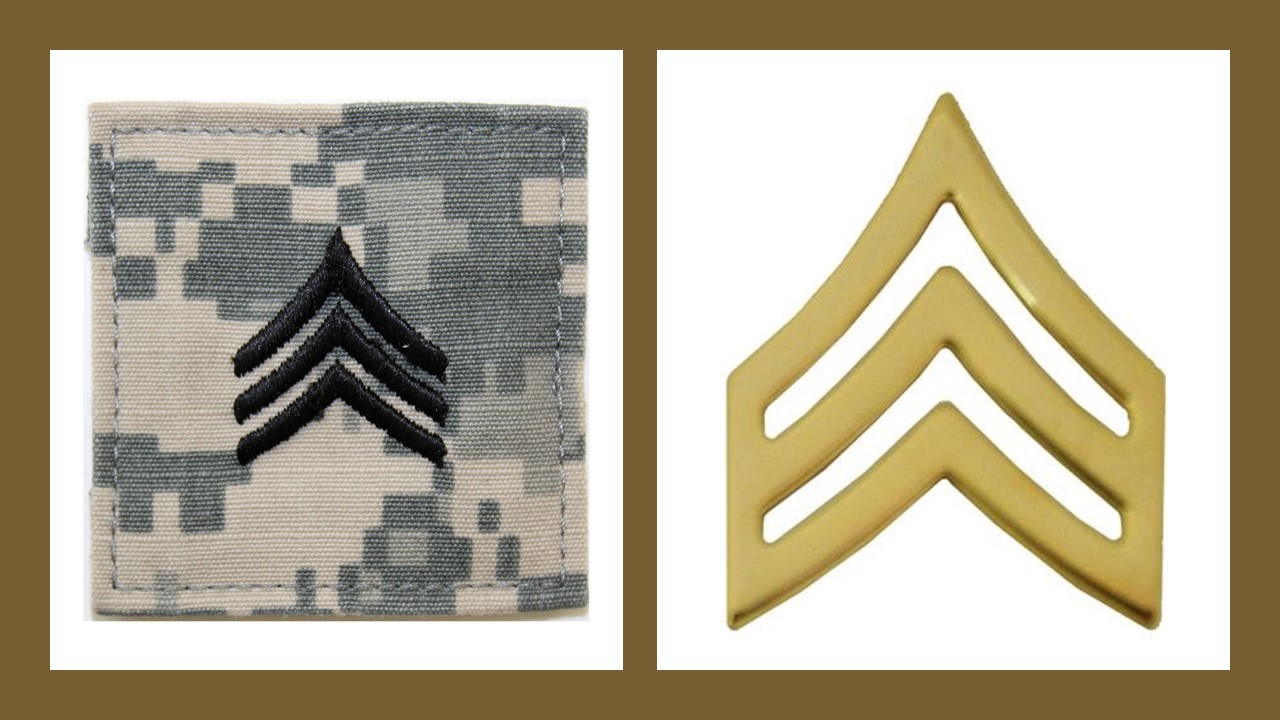
After completing a two-second strengths, weaknesses, opportunities, and threats analysis, I came to attention, turned up my collar to reveal a Sergeant E-5 insignia, and shouted as loud as I could, “Request permission to sit at your table, Master Sergeant,” then remained standing at attention and waited.

The growler did a double-take, and his eyes got real big. “Have a seat, Sarge.”

The other NCO’s at the table were howling with laughter by now. They knew the Master Sergeant, but they didn’t know me. And they had never seen a Major with NCO’s rank under the collar. They found the whole encounter to be quite entertaining.

After the others at the table calmed down, the Master Sergeant said, “OK. Suppose you tell me why you’re wearing that rank.”

“Sure, Master Sergeant. When I was a rookie fresh out of Officer Basic, my first assignment was with an Evacuation Hospital in the California Army National Guard, where I had a great rapport with the NCO’s. When they invited me to attend their dining-in, I thought it was because they wanted me to do the invocation, but that wasn’t it. During the program, the first sergeant pinned the NCO insignia on me and gave me a certificate appointing me to the honorary rank of sergeant, making me an E-5 for Life.”

“Hmmm. And you actually wear it?”

“Yes.”

I wore the SGT Stripes invisibly throughout my entire career. When in the woodland Battle Dress Uniform, it was pinned under my collar. When we switched to the newer army combat uniform, it was velcroed under the collar. And when I wore the Class A uniform or dress blues, it was under the pocket flap, beneath my name. Every time I went to a new unit, I met with the first sergeant or sergeant major, presented the documentation, and asked for permission to wear the rank and be part of the NCO corps. I was always welcomed.

After eight years in the Guard, I became an Active Duty chaplain in the Army Reserve’s Active Guard Reserve program. These chaplains don’t usually deploy, since our role was administrative and training. But while stationed at Fort McPherson, GA, in January 2007, I heard that the U.S. Army Forces Command wanted to send three chaplain teams to Iraq. There were some areas that needed religious support immediately, and Forces Command gave the task to the Army Reserve.

Strong Sense of Calling

As part of the chaplain staff at the U.S. Army Reserve Command headquarters, I had trained many chaplains before they went overseas. But this time I wanted to go. We were running out of chaplains who hadn’t already deployed. More importantly, I felt a strong sense of calling. We had Soldiers in dangerous places with no chaplain, and I wanted to be there with them, so I volunteered. It took a while, but I managed to talk my boss into letting me go.

Those sergeant stripes were under the collar when I went outside the wire with the military transition team. They accompanied me every time I visited wounded soldiers at the medical clinic. I wore them at each memorial ceremony or funeral. They were there for the worship services, the counseling appointments, and the Critical Incident Stress Management sessions. Whenever we had incoming rockets or mortars and we gathered in the bunkers—yep, still had them with me. One time I was eating lunch in the dining facility and the sirens started blaring. In a hurry to get out to the bunker, I forgot my helmet. My Chaplain Assistant grabbed me by the collar and pulled me back inside, “Chaplain, you forgot your Kevlar!” Just then a mortar landed right outside the door. It’s quite possible that she saved my life or prevented injury. See why I love NCOs?

The day after I met the master sergeant in the dining facility, he showed up in my office. The night before, he was feisty and energetic; now he seemed sad and tired. Something had happened.

“Good afternoon, Master Sergeant. What can I do for you?”

 “This morning, I lost a Soldier . . . a close friend. I wanted to know if you’d do a memorial ceremony tomorrow morning before we head out.”

“Of course, I will.”

“And Chaps, I’m sorry about last night.”

“Not a problem, Master Sergeant. I understand.”

“You can sit at my table any time.”

It meant a lot that this senior NCO welcomed me at his table, that he wanted me to be there to honor his friend and that we had overcome the invisible barrier between officer and NCO. In 2015, I retired as a Colonel. But I’ll be an E-5 for life.

* This article appeared in the September 2018 issue of Army Magazine, a publication of the Association of the United States Army.

E5 for Life