God Loved What?

John 3:16 has long been considered to be one of the most important statements in the Bible. Kids have been encouraged to memorize it in Sunday school. Preachers have expounded on it for centuries. Missionaries have gone to the far reaches of the planet to tell people about it. And football fans have created large signs to hold up for the cameras during televised games.

“God so loved the world,” it says. But who or what is it talking about?

“World” in this verse is the Greek word “cosmos” and in Classical Greek, it had to do with order, arrangement, or adornment. In the New Testament, it may be a reference to the universe or to our planet. A second possible meaning has to do with the corruption that we see in the world. And a third definition refers to the people who live on this planet. Human beings.

This is what the writer of the gospel had in mind when he wrote “God Loved the World.” Very clearly, he is saying God loves people. Not some people . . . all people. He doesn’t love some people more than others. He loves all people equally. There are other statements in the New Testament that quite explicitly tell us God doesn’t practice favoritism.

God loves everyone.

At the very end of the Gospel of Matthew, Jesus tells his disciples to take this message to all the nations. To all the “nations”? This is a different word, but the meaning has an interesting overlap with “world.” Nations in the Greek is the word “ethnos” and really means “people groups.” It’s where we get the words “ethnic” and “ethnicity.”

God loves people. Everyone. All people groups. No matter what language we speak. Regardless of the tone of our skin. No gender more than another. It doesn’t matter who our parents are or were or where we came from. God loves people.

What this means to me is that anyone who claims to be a follower of God should adopt his values because in a certain sense, we represent him to the world. And if we’re not in the habit of loving people, we’re not doing a very good job representing the God who is Love.

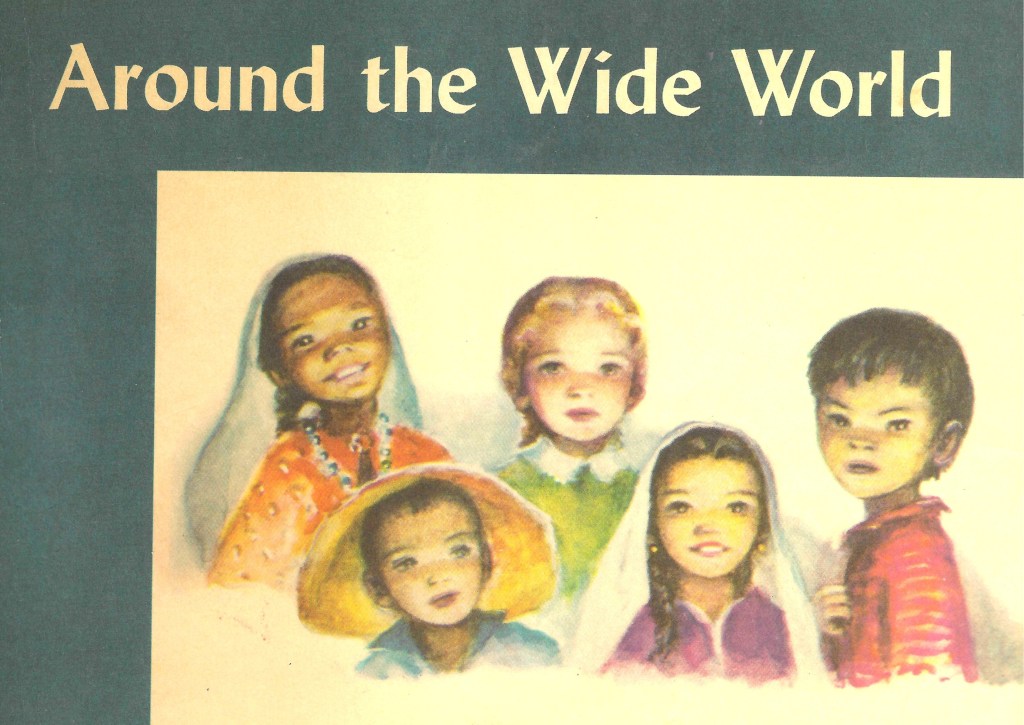
The picture below is the cover of a booklet my wife received when she was a young girl in Vallejo, California. She started attending Sunday School at a nearby Presbyterian church and was given this collection of stories from around the world. Published by the Westminster Press in 1956, and written by W. L. Jenkins.
The Little Door

The exterior of a butterfly egg has at least one tiny opening called a micropyle, while the egg of a different species may have an entire “system of tiny canals.” These microscopic openings permit the entrance of the sperm, so that the egg may be fertilized shortly before it is deposited by the female. Interestingly, micropyle is the transliteration of a Greek compound word meaning “little doors” or “little gates.” Plant and insect eggs have these miniature openings. Otherwise, there would be no fertilization.

Jesus mentioned moths and gnats in his teaching, but I don’t know whether he ever talked about their eggs. But he did talk about doors and gates. In fact, he specifically mentioned a small gate in the Sermon on the Mount:

Enter through the narrow gate. For wide is the gate and broad is the road that leads to destruction, and many enter through it. But small is the gate and narrow the road that leads to life, and only a few find it (Mat 7:13-14).

Later on, he said, I am the gate; whoever enters through me will be saved (John 10:9).

There’s another scripture that ought to be included in this discussion. Behold, I stand at the door, and knock: if anyone hears my voice, opens the door, and welcomes me in, I will come in and fellowship (Revelation 3:20, paraphrased). This is a specific invitation for Butterfly Believers who are looking for spiritual direction and fulfillment.

A friend of mine has a saying: “Christianity isn’t a religion; it’s a relationship.” I like that emphasis because it captures the essence of what Jesus is all about. Living for Christ is not about liturgy, ritual, traditions, or rules, even though many of those might be good and helpful. I’ve discovered that genuine Christianity involves growing a deep relationship with the Savior who calls himself our friend.

Metamorphosis

Romans 12:2 indicates that we are to be transformed by the renewing of the mind. The word in the Greek text is where we get the English word metamorphosis. Translated as transformed, it is what we use to describe the continuous, remarkable change of form or structure in an individual after hatching or birth.

Several insects undergo complete metamorphosis, such as bees, ants, ladybugs, wasps, and flies. But the most spectacular of the metamorphosing creatures are the butterflies. This is because they are safe, easy to observe, and they are beautiful. These marvelous creatures are called Lepidoptera, which means scaly wings.

Butterflies are special to me for several reasons. First is the fact that they represent the internal and external changes that take place when a person comes to faith in Jesus Christ. Second is the mystery, or as some writers call it, the “magic” of the changes that occur during the transformation process. Third is the gorgeous coloration of so many species. They are delightful to find and examine.

Amazingly, transformation occurs in every stage of the butterfly’s life. There is never a day when an egg, caterpillar, chrysalis, or butterfly is the same as it was the day before. Theirs is literally a continuous transformation. This is also true of people. We are always growing, changing, and becoming. There’s always more to learn, and always room for refinement.

The bottom line is that I find butterflies to be interesting and fun. In the same way, living for Jesus Christ is supposed to be interesting and fun. Many of the terms and processes we use when talking about butterflies are perfect for discussing our growth as children of God.

May the Lord continue his remarkable work of shaping and transforming each of us into his image.