Attitude Check!

I used to drive more than 50 miles to work, and the same distance home in the evening. The traffic was usually pretty bad, often rainy, and as you’ve probably experienced, other drivers are sometimes not very nice. When I started despising drivers who made stupid decisions, I developed a bad attitude and realized I needed to do something about it.

After praying, I decided to come up with a phrase I could say whenever another driver irked me. Here’s what I ended up with.

You are a fabulous human being, fashioned in the indelible image of the Creator.

After I memorized the sentence, I started saying it whenever a driver did something dumb or dangerous: ten, eleven, a dozen times a day. Nobody else knew what I was doing. I’m the only one who heard me, even though I said it out loud. It helped me remember that every man and every woman has the divine image, even those who are not living for the Lord. Even those who are terrible drivers.

Being in God’s image and likeness is an important part of the Judeo-Christian world view. We’re not merely the product of a godless evolutionary process. While we may have many similarities with the animals, what distinguishes us from the rest of creation is the image of God. The very first page of the Bible says,

“God created man in His own image; He created him in the image of God; He created them male and female. God blessed them, and God said to them, ‘Be fruitful, multiply, fill the earth, and subdue it. Rule the fish of the sea, the birds of the sky, and every creature that crawls on the earth.’”

The Westminster Shorter Catechism poses the question, “How did God create man?” And then provides the answer, “God created man male and female after his own image, in knowledge, righteousness, and holiness, with dominion over the creatures.”

To be in God’s image has two meanings. First, it means we are like him. Second, it means we represent him.

How we are like God refers to his activity and character and the ways we are like him. God communicates. He creates. He relates. He loves. He keeps his word. He is loyal. He is compassionate. He has knowledge. We can make these same statements of human beings because we are fashioned in his image. We have the ability to create, to communicate, to relate, and to love. We have moral capabilities such as loyalty and honesty. We have the ability to show compassion. We have the capacity for knowledge. And like our creator, we have the ability to make our world a better place.

The fact that we represent God has a different focus and a different starting point for how we think and live. The emphasis is not on how we are like God, but that we represent the Lord. We represent God and his values to the planet and to other people. We represent him in matters of social justice and spirituality, which is why Christians should be involved in the community, setting an example of alleviating pain in the world, and caring for the needy.

In 2 Corinthians 5:20 the apostle writes, “Now then, we are ambassadors for Christ.”

Not only do we have the divine image, we have the Holy Spirit in us, another powerful reason for understanding we are to represent the Lord at all times, even when driving on the freeway.

divider-2461548 (2)

This devotion was published at https://www1.cbn.com/devotions/attitude-check and is an adaptation from the author’s book WisdomBuilt Biblical Principles of Marriage, Copyright © 2019 Paul Linzey, used with permission.

professional-transport-4458797_1920

Training for Ministry

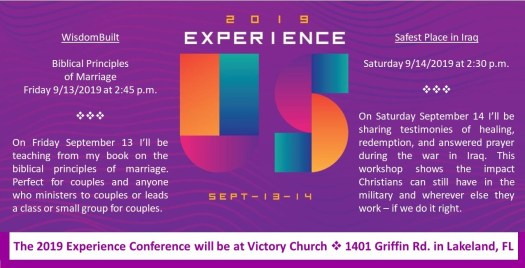
Experience Conference September 2019

I’m excited that on Friday September 13, I’ll be able to share the Biblical Principles of Marriage, which was the subject of my first book. Then on Saturday the 14, I get to tell about some of the fascinating experiences I had in Iraq as an Army chaplain, which is what my second book is about. Although I am speaking as a volunteer and will not be paid, there is a cost to attend the program. If you want to find out more, click on the image above. Please pray for me and the entire conference as we help others prepare for the ministries God has called them to.

Falling in Love All Over Again

Successful Marriage

I like the message about falling in love with the same person. That’s exactly what it takes to grow a marriage that lasts a lifetime . . . whether you’re 20, 40, 60, 80, or somewhere in between!

Click on the picture above if you want more information about the 4 Habits online summit. And of course, you’re always welcome to message me through the Contact page of this site. Blessings to you!

4 Habits to Transform Your Marriage

Next month the 4 Habits online marriage seminar begins! Forty different sessions over six weeks (but you have access to the videos a lot longer so you can revisit them or watch them at your convenience and at your own pace), more than twenty speakers: definitely worth much more than the price to gain access to the material. Click on the picture below to find more information about the online marriage summit.

Happy Couple


Charisma Media Interview


In June, I was invited to Charisma Media for a Facebook Live interview about my book, WisdomBuilt Biblical Principles of Marriage. Chris Johnson was really good at conducting the interview, and I had a great time. It was fun, and gave me a chance to talk about marriage, the Bible, and a few things I really care about.

Charisma Magazine Logo (3)

Marital Mistakes

Mistake #1: It’s not going to rain, I’ll ride my motorcycle to the store.

Mistake #2: After the rain subsided, I made it to my bike not too wet. Then I rode home, and drove right back into the storm, arriving totally soaked.

Mistake #3: Agreeing to my wife staying an extra week with our son, whose wife just had a baby. Had she come home with me, we would have both gone to the store, and we would have been in the car, and I wouldn’t have gotten drenched.

Mistake #4: Therefore, it’s my wife’s fault I got soaked.

rain-84648_1920

The Power of Forgiveness

It’s crucial that you understand the power of forgiveness. When you forgive, you release yourself and the other person from the pain and wrongs of your joint past. But forgiveness doesn’t happen quickly. According to Christian ethicist Lewis Smedes, it happens slowly, with a little understanding, and sometimes with some confusion, because it has to sort out the anger and the injustice. When forgiveness has finished its work, however, both the forgiver and the offender have been renewed, transformed, and set free from the pain of the past.

Sometimes, you have to forgive the person you’re still in relationship with because there’s been unfaithfulness, a betrayal, neglect, or abuse. This is hard, but with God’s help, and sometimes the help of a good pastor, counselor, or friend, you can be successful at putting the past behind you and moving forward in a fresh start.

Forgiveness doesn’t mean there will be no scars. You carry the consequences of pain long after the hurting stops and the forgiveness is complete. The Christian singing group Point of Grace has a song that talks about the impact of the ugliness, pain, and shame of the past, which are often followed by scars that remain for a lifetime. Heal the Wound, written by Clint Lagerberg and Nicole Nordeman, focuses on the metaphor that even after an injury has healed, there’s often a scar that lasts a lifetime. But instead of seeing the scar as a negative, they reframe it as a reminder of how gracious the Lord was in bringing you through the struggle.

forgive-208824_1920

God Is My Helper

You can probably think of several characters in TV shows, comic books, movies, and novels who have a sidekick. There are lots of them: Sherlock Holmes and Dr. Watson, Batman and Robin, The Lone Ranger and Tonto, Han Solo and Chewbacca, Don Quixote and Sancho Panza, Andy Griffith and Barney Fife, Captain Kirk and Spock, Robinson Crusoe and Friday, Robin Hood and Little John, Shrek and Donkey, Moses and Aaron, Paul and Silas.

It seems almost every hero has a sidekick who provides comic relief, but also offers serious friendship and assistance along the way. It’s a classic technique in literature and drama, where sidekicks play an important role. They help the main character reach his or her goals and accomplish the mission. They offer friendship and provide insight. Usually, they perform tasks that are beneath the dignity of the hero. Sometimes they serve as a contrasting personality. The sidekick may be a commoner or a bumbler, allowing the audience someone they can relate with. Usually, the sidekick isn’t quite as smart, but helps the star come up with brilliant ideas. Always, the sidekick is of lesser importance.

A lot of people think of a helper as someone who is less important, less skilled, or less capable than the person who really matters. In our culture, a helper is considered an underling, a hireling, or a subordinate. We call them gophers. We even talk about the hired help—people who do the tasks the important people don’t want to do or don’t have time to do. Words like assistantadjunctapprenticedeputy, and sidekick come to mind.

However, that’s not the biblical concept of help. The Hebrew word for helper in the Old Testament is ezer, and comes from a verb that means to rescue, deliver, or help. Whenever it’s used of human beings, it’s talking about someone who is bigger, stronger, more powerful, smarter, or richer who reaches out to the weak or needy.

Most often, the word refers to God himself. The psalmist wrote, “God is my helper; the Lord is the sustainer of my life” (Psalm 54:4) and “God is our refuge and strength, a helper who is always found in times of trouble” (Psalm 46:1).

The point is that helping people is what God does. He’s always ready, willing, and able to help us in our time of need. No wonder Hebrews 4:16 encourages us to “approach God’s throne of grace with confidence, so that we may receive mercy and find grace to help us in our time of need (NIV).

Do you need help? Are you struggling at this point in your life? Have you felt like quitting or giving up? Let me encourage you, instead, to turn to the Lord and enter into his presence with confidence. You will find the help you need. That’s what God does. That’s who he is.

cloud-2877172_1920

Who’s More Important?

Before getting married, it’s healthy and right to be loyal to one’s parents, siblings, and friends. But once you get married, the primary loyalty has to shift to the new spouse.

It’s not that you have to cut off relationship with your family and friends No, you still want them and need them in your life. But the spouse must become the new priority, and has to feel more important than the in-laws and others. To the extent you’re willing and able to let go of prior loyalties, you can form new ones. Likewise, to the extent that you can’t or won’t change priorities, your marriage will suffer.

While Genesis 2:24 states that it is the parents you must leave in order to form a new unity, there are others, as well. These might include a boyfriend, girlfriend, or a previous lover. In fact, there may be a number of people and situations included in what you let go of: friends, abuse, wealth, lifestyle, job, fame, high school sports, or any number of things in one’s past.

Your Past Can Ruin Today

One couple lost a son in a terrible accident. Unable to let go of that pain and loss, not knowing how to heal, and unwilling to forgive, the woman drove her husband to divorce. She allowed the past to ruin their marriage by allowing it to remain in the present. She kept the pain alive.

But it’s not just the negative that has to be left behind. Sometimes you have to let go of some positives: the good old days, a happy first marriage, that perfect job, a previous home and neighborhood, wealth or fame, or even a dream or ambition. An athlete whose playing days are over is often headed for emotional and relational disaster. A Soldier whose career comes to an end, sometimes can’t adjust to being a civilian and finding a new identity.

Someone who loses a leg or an arm in an accident at work might have a tough time accepting the new reality and letting go of the previous physical ability. Retirees sometimes struggle with letting go of their previous life, identity, and sense of importance. Empty-nesters also face a difficult struggle when the kids are gone. These transitions are tough.

Sue Augustine writes, “All of us can think of something we’d like to be set free from. For some, it’s hurtful memories, past regrets, or bitter resentment. For others it’s sorrowful remorse, frightful insecurities, or deep-rooted grudges. Imagine what it would be like to be free . . . . There is hope for you or someone you know who struggles with an imperfect or painful past.”

Her book When Your Past Is Hurting Your Present is arranged in three sections: Relinquish Your Past, Renew Your Present, and Rebuild Your Future. This is good guidance for couples who are still fighting or struggling with letting go of the past.

Bottom Line: make sure you live each day knowing that your spouse is the most important person in the world.

3

Like Father, Like Son

Families have a powerful influence on you throughout your life. Parents, siblings, and extended family shape you, teach you, and help establish your values and worldview. A lot of people look like, sound like, and think like their parents, sometimes even the ways they laugh, sing, or walk. I read about some cities that have an annual father-son and mother-daughter look-alike contest, and the entries are fascinating. It takes just a few minutes on a computer to find some hilarious parent-child look-alikes.

Personal interests, skills, and education often come from parents. It’s pretty common for a child to grow up and go into the same line of work as mother or father. People tend to follow their parents’ preferences in politics and religion, too. It makes sense, because parents set the tone in the home their children grow up in, and what the kids experience there, usually becomes the norm.

There’s a short film about an interview with a Qantas Airline pilot whose son became a flier for the same airline. Steve Gist and his son, Taylor, eventually were assigned to fly together, with the dad as the lead pilot, and the son as the co-pilot. It’s a great story, demonstrating some of the ways kids learn skills, knowledge, interests, and even careers from their parents.

I know of preachers’ kids who become ministers, school teachers’ kids who go into education, athletes’ kids who play ball. The same happens with hobbies. In June 2011, two men (father and son) both scored their first-ever 300-point game at the same bowling alley during the same week.

When I was in high school, I played Lieutenant Joe Cable in the musical South Pacific. One of the songs was titled “You’ve Got to Be Carefully Taught.” According to lyricist Oscar Hammerstein II, we pick up hate and prejudice from our families.

We also learn how to behave in relationships from our families of origin, and that’s what brings us to this principle. You see, most of us don’t have very good role models when it comes to marriage. My wife and I both came from parents who had a pretty bad marriage, so when we got married, we didn’t know what to do. We loved each other, but didn’t know how to treat each other in positive ways, day after day.

When talking about letting one’s past influence the present, we often say the person is carrying some baggage. What we mean is, there’s been some pain, abuse, or failure in the past, and the person hasn’t finished dealing with it, letting go of it, healing from it, or forgiving the people involved. Whatever is in “the baggage” still has a negative impact on present-day relationships and attitudes.

Not all of the baggage we carry through life is painful or negative, though. In fact, sometimes it’s the good stuff in our past that gets in the way of building a good marriage. People who come from a good family often have just as much difficulty forming a new marriage, because of the influence of the parents.

The second Biblical Principle of Marriage is found in Genesis 2:24: This is why a man leaves his father and mother and bonds with his wife, and they become one flesh. I call this verse the Old Testament equivalent of Philippians 3:13-14, But one thing I do: Forgetting what is behind and reaching forward to what is ahead, I pursue as my goal the prize promised by God’s heavenly call in Christ Jesus. The point of these scriptures is that in order to fully live in the present, you have to let go of the past.

dad-909510_1920