Counting the Cost

The average female butterfly will deposit from one hundred to three hundred eggs, some will produce as few as a dozen, and others more than a thousand. Some butterflies will place the eggs on the leaf one at a time. Others will deposit a group or a cluster of eggs, stacking them neatly, one on top of another. Still others will release a mass of eggs in a pile. Whatever method the butterfly uses, she will glue them onto the leaf, stem, or flower to make sure they won’t come off. The glue is so strong that it’s impossible to remove the egg without destroying the creature inside.

There are two similarities to Butterfly Believers I’d like to point out here. First, in the same way some eggs are laid one at a time and others are piled or grouped in a mass, some people come to faith in Christ individually while others are part of a large gathering where there may be hundreds who respond to the gospel at the same time.

The other similarity has to do with the church or fellowship we choose to attend. Some people live in a place where there is no church or congregation, so they worship, read the scriptures, and pray all by themselves. Many people around the world attend small churches of anywhere from ten people to fifty or sixty. And a lot of people prefer what may be called a megachurch, which may have hundreds or thousands gathering at the same time and place.

I met one man who dreamed that he met Jesus. That dream led him to “count the cost” and commit his life to Christ, even though he lived in a place where there was serious persecution. The expression “count the cost” comes from Luke 14:28, where Jesus said to a large crowd:

For which of you, intending to build a tower, does not sit down first and count the cost, whether he has enough to finish it? Later, when talking to his disciples, he told them, Whoever wants to be my disciple must deny the self, take up his or her cross and follow me (Matthew 16:24).

I was six years old when my mother took our family to a camp meeting in a revival tent. Listening to the preacher, I understood for the first time that Jesus went to the cross for my sins. I turned to my brother and said, “I’m going up to get saved,” and he replied, “Me too!” We ran up the center aisle, around to the wooden benches behind the platform, and knelt until someone came and prayed with us. I don’t remember if there was anyone else praying to receive Christ as Lord and Savior that night, but there were at least two of us.

Years later, I attended several Billy Graham rallies in huge stadiums. When Dr. Graham gave a salvation altar call, literally hundreds of people left their seats, found their way to the ball field below, and en masse, committed their lives to Jesus Christ. It was an individual decision each person had to make, but it happened in a much larger setting than my boyhood experience or the man who had the dream.

There are many ways to come to and participate in the body of Christ. Size or numbers isn’t the point. What matters is devotion to the Lord, growing in your faith, and recognizing that you are part of the family of God.

This is an excerpt from the book, Butterfly Believers, a collection of devotional readings based on Romans 12:2 and butterfly metamorphosis. Paul Linzey is a former pastor & military chaplain, now teaching Spiritual Formation and Practical Ministry at Called College & North Central University.

Danger, Dust, and Death

When they told me where I was going, they said it was the Safest Place in Iraq, but by the time I got there, things had changed. On a Tuesday night, the dining facility was crowded, bustling, with hardly an empty chair, when mortars landed on the building.

People were stunned, walking around like zombies. Most avoided eating in the DFAC, even after it was repaired and they started serving meals again. From that moment, incoming mortars and rockets became part of the routine that was soon to be my daily life.

Men from Diwaniyah would drive to a vacant field on the edge of town, bringing their rockets and mortars to fire at us. They did this in the morning on their way to work. Sometimes it was mid-day during a lunch break, and other times in the evening on their way home from work. Occasionally it was in the middle of the night. Some of the people shooting at us were teens or even younger. Often, they would launch their missiles-of-death just before, or right after their prayers.

I volunteered to go. My philosophy as a chaplain was that I wanted to be wherever soldiers had to go, and if they were at war, I wanted to be there with them. Not because I enjoy fighting. We all know that a chaplain is a non-combatant. I wasn’t there to fight.

I was there to encourage, counsel, and pray; provide worship opportunities, friendship, and guidance; nurture the living, care for the wounded, and honor the dead; and guarantee the constitutional freedom of worship to men and women of all faiths, and the same freedom to men and women of no faith. Camp Echo was my home, my parish, my fiery furnace.

I knew from the start that I could be wounded or killed. It was a weird feeling, and I came to accept it. How or when, I had no idea. But every time there was another explosion, I wondered if this was the day.

My wife also knew I might not make it home alive. Or if I did return, I might be a broken man–crippled, blind, psychologically damaged, or all of the above. With that possibility in mind, she told me before I left home, “I don’t want to find out after you get back or after you’re dead that you were in danger. I want to know right away.”

The first time I mentioned during a phone call some of the dangerous things that were happening, she said, “I already know. I saw it on TV and in the newspaper. They’re mentioning Diwaniyah and Camp Echo by name.” She scanned and sent me an LA Times article. I took it to our staff meeting the next morning, and discovered that many on our leadership team didn’t know what was going on outside the wire.

Danger, dust, and death formed the context for the job I was sent to do. Operating from the philosophy that “ministry follows friendship,” I built relationships among the men and women at Camp Echo: military, civilian, American, and Coalition. This allowed me to be there when they were at their best and when they were at their worst, in their strongest moments and in their weakest.

In the heat of the battle and the heat of the desert, hours turn into days, which transition to nights, and add up to weeks and then months. The conditions wear you down, leaving an imprint on your mind and your soul: images that will be seen in dreams for months or years, sounds that reverberate long after you’re home, people you befriended and cared about and stared at death with, but will probably never hear from again. For many of us, it’s only memory now. But for others, the war continues … on the inside.

An excerpt from the book, Safest Place in Iraq, published by Morgan James Faith.

What’s for Dinner?

When it’s time to lay the eggs, a female butterfly searches for the appropriate host plant for her youngsters to grow up on. She instinctively knows that her hatchlings are limited as to what kind of plant they will eat, and places her eggs only on that plant.

When the caterpillars emerge from the eggs, they will stay on that particular host plant until they are adults who can fly. People who want to attract certain kinds of butterflies will do a little research to find out what that breed will eat, because the egg-laying butterfly won’t be fooled. For example, a Monarch eats only milkweed. A Viceroy has a few options: willow, poplar, aspen, apple, cherry, or plum. The Zebra Swallowtail needs pawpaw. And the Pearl Crescent is limited to asters. The list goes on and on, and is particular to each variety of butterfly.

The context for this discussion is Romans 12:1-2, so it may be helpful to understand that we are instructed not to conform to the pattern of this world, but be transformed by the renewing of your mind (Romans 12:2). According to the extended metaphor of metamorphosis, the food we’re concerned about is what we’re feeding our minds, because that’s the point in this verse and in our day-to-day lives. It’s crucial that we select the appropriate “host plant” for our mind and spirit.

The kind of Butterfly Believer you are will determine what you feed on, where you spend your time, what you read, who you hang out with, and what you choose for entertainment. A few relevant questions include: “Who and what are you allowing to influence you?” “Are your choices helping you to be strong in your faith and more faithful as a follower of Christ?” “Are you developing a keen sense of discernment, or like the butterflies, a well-developed instinctive knowing what is right or wrong when it comes to feeding?”

The apostle Paul wrote to one congregation: Finally, brothers and sisters, whatever is true, whatever is noble, whatever is right, whatever is pure, whatever is lovely, whatever is admirable—if anything is excellent or praiseworthy—think about such things (Philippians 4:8).

There is no “one size fits all” approach. What you do to care for and feed your mind and your spirit is extremely important, but also highly personal. Like the butterfly that looks for the right host plant to land on, you have to discover what works for you. And yet, you can also learn from others. As it says in Philippians 4:9, Whatever you have learned or received or heard from me, or seen in me—put it into practice. And the God of peace will be with you.

The above is an excerpt from the book, Butterfly Believers.

Captain Interrogative

Several years ago, when I was a brand new Active Duty Army Chaplain, I got a call from an Army chaplain recruiter. A pastor of a Baptist church in Southern California had called to ask about becoming a chaplain. Although the pastor was in a wonderful church and was doing a great job as their pastor, he felt that the Lord might be leading him to redirect his pastoral and discipleship efforts to Soldiers, instead of among civilians.

I asked the recruiter why he was telling me about the pastor, and he said, “The guy’s wearing me out with his questions. He literally calls every day of the week with another couple of questions. And after I answer the question, he has ten more. I’m not exaggerating here!”

I agreed to take on the challenge of staying in touch with the pastor, and I called him. He admitted that he always has lots of questions, even to the point that while he was in seminary, classmates referred to him as Captain Interrogative.

“Here’s the deal I’d like to make with you,” I said.

“Deal?”

“Yes, deal. I’m willing to answer every question you come up with, on two conditions.”

“Conditions?”

“Yes, conditions.”

“OK, what are they?”

“First, you may call me or email me up to three times a week, Monday through Friday during the workday. Second, you will keep a record of every question you ask and every answer I provide.”

“Oh yeah? Why?”

“You have a right to know everything you possibly can know before making the decision to transition from your church ministry to the military. Since you and your wife need to pray over this potential move together, you need to keep a notebook that you can both review from time to time. And after you have the answers to all your questions, you’ll have a large notebook full of information about ministry in the military, and who knows, maybe you’ll be able to help someone else someday.”

The guy agreed, and boy did he have a ton of questions. In the process of Q&A, he and I became good friends. My wife and I even visited his church to see him in action and meet his wife. After about six months, he had a fat notebook filled with everything he needed to know about military chaplain ministry. He made the decision to apply and was selected.

It’s important to keep in mind that ministry in the military is in many ways the same as ministry in a local congregation. Men and women in the uniformed services have the same needs as those who are schoolteachers, plumbers, mechanics, or salespersons. The context is different and there are some issues particular to the military, as there are in any field. But Soldiers, Sailors, Airmen, Coast Guardsmen, and Marines need someone to teach them the Bible, provide pastoral counseling, visit them when they’re sick, model effective relationship styles, and set an example for how to live for Jesus, just like anyone in any town in America.

The above is an excerpt from the book titled Military Ministry: Chaplains in the Twenty-First Century, written by Paul Linzey and Keith Travis, published by Wipf & Stock.

Gazing at the Destruction of Pearl Harbor

It was more than half a century ago that I stood on the deck of the aircraft carrier USS Yorktown and gazed in awe at the recent destruction of Pearl Harbor. My sailor friends and I were very young then, but a few months later, the Battles of the Coral Sea and Midway would make men of us quickly.

Since those decisive days, many fine accounts have been written about those key battles but generally in a secular context for the historian’s interest. They have enhanced our knowledge of the war in the Pacific and particularly of those great battles, and we are indebted to them, but there was another side to the story that never has been told.

During that early period of World War Il, I was in the U.S. Navy serving as an enlisted musician on the aircraft carrier Yorktown, which was a major player in the Battles of the Coral Sea and Midway. From my experience in the ship, I observed the supernatural intervention of God that played a vital role among both officers and enlisted men. I wish to bring some of that story into focus for the families and friends of the Christian religious community whose loved ones served so heroically in those critical events of the war.

I am writing for all the military personnel who served in those actions and particularly for the survivors of the Yorktown and their families and friends. The Yorktown (CV-5) Club, which I currently serve as chaplain, meets annually to relive the events and to keep alive the spirit for which we served. I am grateful to the club members for the camaraderie and spirit of fellowship that have endured through the years and are ignited each year anew as we meet together.

I am writing for those many Christians who may not pursue secular history as such but would appreciate reading history that takes into account God’s intervening force in the lives and events of the people involved. Many prayed for their men and women during those dark hours of World War Il and believed that God heard and answered their prayers, and those of us who benefited from their intercessory prayer continue as witnesses to God’s grace.

Divine providence is as relevant today as it was in Bible times. Events do not “just happen.” The Battles of the Coral Sea and Midway are cases in point, for we did not win those battles by our wits alone. The odds were stacked against us at Midway, but in answer to the prayers going on back home in our great nation, the enemy forces made crucial mistakes at Midway. Those errors cost them the loss of ships and men, which resulted in their defeat and the turning of the tide in the war.

I am writing to give testimony to God’s presence in the most difficult of times and to witness to the saving grace of Jesus Christ. My hope is that this testimony might be an encouragement to others who find themselves in uneven circumstances. Also, I wish to encourage others to be faithful to God and to one another in any and all eventualities, good or bad.

I am writing for my children who have not known what their father went through during the war. One of my daughters wept as she read the account of the sinking of the Yorktown and remarked that her brothers and sisters did not know these things.

Finally, I write to remind myself of God’s divine favor and providence lest I forget the time when I felt so alone and helpless. Lest I forget. Lest I forget.

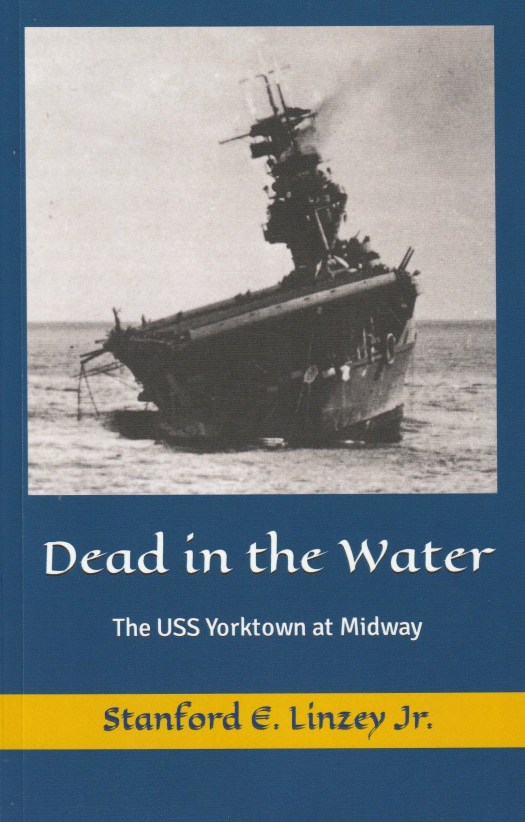
This is an excerpt from the preface of my dad’s book, Dead in the Water. It is available on Amazon and on this website. Captain Stanford E. Linzey was a sailor on the USS Yorktown during WWII. After the war, he served as a pastor for a decade, and then returned to the Navy as a chaplain. The image below was provided by Pixabay.com.

USS Yorktown: The Fighting Lady

Built from 1934-1936 and commissioned in 1937, the USS Yorktown was involved in some major battles in WWII and received the nickname . . . The Fighting Lady. There were four announcements that the crew of 2,217 sailors and about 300 aviators didn’t want to hear.

1. “Battle Stations!” That meant they were about to enter combat.

2. “Fire!” This didn’t mean to shoot at anyone. It meant there was a fire on board the ship. The ship was home, and there was no front or back door to leave a burning inferno, so fire was a dreaded enemy.

3. “Stand by for attack!” In battle, everyone from the captain to the newest recruit knew he might be killed.

4. “Abandon Ship!” This one was nerve-wracking because the nearest land was three miles away–straight down! And sharks were not the kind of company they preferred.

Dad was on the Yorktown each time it engaged the enemy. With headphones on, he heard the blood-curdling words, “Zeros at 50 miles out!” These Zeros, sometimes called Bandits, were Japanese fighter-bombers and torpedo planes.

“Zeros at 25 miles out. Stand by for air and torpedo attack!”

Dad’s mind raced back to the battle of the Coral Sea just four short weeks earlier. It seemed like a year ago, yet it felt like yesterday. An armor-piercing bomb hit the flight deck and sliced through three more decks before exploding in the room next to his station. It immediately obliterated 35 of his shipmates, but if it had been eight feet closer, it would have also splattered Dad.

Dad’s job was to pass reports to damage-control crews who then fought their way through the rubble and did their best to put out fires, make repairs, and keep The Fighting Lady afloat.

But he did much more than that. Through his interaction with men of all rank, he taught them how to face adversity, face hardship, and even face death with head held high and without fear. He revealed his faith in God when the world seemed to be falling apart, and shared emotional and spiritual strength through personal conviction.

2nd Class Petty Officer Stanford E. Linzey, Jr., loved the Lord, loved life, and loved people. He never hated anyone, including the Japanese. But he was a man with high integrity, and to the best of his ability, he did his job to help his country.

The above is an excerpt from the introduction to the book Dead in the Water. The book was written by Captain Stanford E. Linzey, Jr., CHC, USN, Retired. The introduction was added by my brother, Stanford E. Linzey III. I plan to post several excerpts leading up to December 7, also known as National Pearl Harbor Remembrance Day.

Pearl Harbor

I’ll never forget what he said, or the look on his face as he relived the hell of battle. Dad’s words were bathed in emotion. Hardened by the intense heat of battle, he still choked up at times as he remembered Guadalcanal, Gilbert Islands, Coral Sea, and Midway. He repeated “Coral Sea,” hesitated, breathed deeply and said, “Midway.”

Did I detect anger? Or was it sorrow?

Dad won the Texas State High School Championship as a clarinetist in the school band, then joined the navy in 1938 as a musician. In peace time he played the clarinet in the USS Yorktown Band, and the saxophone in the jazz band. But in battle he was an intra-ship radioman, assigned to the aircraft carrier, USS Yorktown CV-5.

Dad was a Texan, as was Admiral Chester Nimitz, and often told me of battles in Texas history. Sentences we read without emotion in history books became commands bathed in blood and tears when Dad said them. If you’re not a Texan, Remember the Alamo! and Remember Goliad! could mean almost nothing to you. But it sometimes brings tears to my eyes and raises goose bumps on my arms because my Dad was a Texan! No, he didn’t fight at the Alamo in 1836 or at Goliad in 1835, but he made sure that I, his oldest son, knew about them.

Dad didn’t join the navy to kill people. He didn’t even want to go to war. As a nine-year-old boy, when he had the privilege of seeing John Philip Souza on Souza’s last tour with the United States Marine Band, he was inspired and dedicated himself to music. Becoming an award-winning musician, he wanted to join the United States Navy Band. Fighting a war was not on his radar screen. However, personal plans and goals don’t always develop to our liking. In this case, Japan bombed Pearl Harbor on December 7, 1941.

The above is an excerpt from the introduction to the book Dead in the Water. The book was written by Captain Stanford E. Linzey, Jr., CHC, USN, Retired. The introduction was added by my brother, Stanford E. Linzey III. I plan to post several excerpts leading up to December 7, also known as National Pearl Harbor Remembrance Day.

A Divine Call to Ministry

The call of God is one of the most important points in your thinking about becoming a military chaplain, and this call has professional, personal, and spiritual dimensions.

The professional side of the call has a lot to do with how the military looks at you and your work as a chaplain. When a minister goes to an accessioning board to apply for for Active Duty, Reserve, or National Guard for the Army, Air Force, or Navy, one of the topics each candidate will have to respond to is “Tell us about your call.” An applicant should be able to communicate a definite experience when the Lord called him or her to become a military chaplain.

There is also a personal side to the call to military ministry. Fulfilling the call of God on your life isn’t easy. There will be tough days. There may be times you feel like quitting or throwing in the towel. You have to do physical training when you’d rather be relaxing with your family or spending time with friends.

There is also a spiritual side to the call. In 1994, Christian musician Steven Curtis Chapman wrote a song titled “Burn the Ships.” The song tells the legendary story of Hernán Cortés, the Spanish conquistador who sailed from Spain with a fleet of ships to conquer the Aztecs in Mexico. After arriving, some of the men were homesick, fed up with being away from family and the life they knew, and threatened to return to Spain. Cortés responded by ordering the ships to be destroyed so his men had no way to leave. The lyrics include the devotional application that when we make a decision to follow Christ, there’s no going back. In essence, sometimes we have to “burn the ships” in order to remain faithful to the Lord and his call on our lives.

The point is this: if you obey the call of God to minister as a military chaplain, the Lord will strengthen you. God called you to the work, God will prepare you for the work, and God will sustain you in the work.

A specific divine call to any ministry will change the direction of your life. It will motivate you and lead to new behaviors and habits. It will give you the strength, stamina, and tenacity that you’re going to need if you’re to run the race and finish the course. And just as important, the call will come with a divine anointing, and the promise that the lord will be with you every step of the way.

The call of God, therefore, is undoubtedly one of the most important points in thinking about becoming a military chaplain, and this call includes the professional, personal, and spiritual dimensions of your life. If you aren’t sure, then take more time to pray and seek God until he confirms his call for your life’s work. There must be no doubt. There’s no room for wondering whether this is where you are called to serve. You don’t have the luxury to guess or assume. You have to be certain.

This is an excerpt from the book Military Ministry: Chaplains in the Twenty-First Century.

The Little Door

The exterior of a butterfly egg has at least one tiny opening called a micropyle, while the egg of a different species may have an entire “system of tiny canals.” These microscopic openings permit the entrance of the sperm, so that the egg may be fertilized shortly before it is deposited by the female. Interestingly, micropyle is the transliteration of a Greek compound word meaning “little doors” or “little gates.” Plant and insect eggs have these miniature openings. Otherwise, there would be no fertilization.

Jesus mentioned moths and gnats in his teaching, but I don’t know whether he ever talked about their eggs. But he did talk about doors and gates. In fact, he specifically mentioned a small gate in the Sermon on the Mount:

Enter through the narrow gate. For wide is the gate and broad is the road that leads to destruction, and many enter through it. But small is the gate and narrow the road that leads to life, and only a few find it (Mat 7:13-14).

Later on, he said, I am the gate; whoever enters through me will be saved (John 10:9).

There’s another scripture that ought to be included in this discussion. Behold, I stand at the door, and knock: if anyone hears my voice, opens the door, and welcomes me in, I will come in and fellowship (Revelation 3:20, paraphrased). This is a specific invitation for Butterfly Believers who are looking for spiritual direction and fulfillment.

A friend of mine has a saying: “Christianity isn’t a religion; it’s a relationship.” I like that emphasis because it captures the essence of what Jesus is all about. Living for Christ is not about liturgy, ritual, traditions, or rules, even though many of those might be good and helpful. I’ve discovered that genuine Christianity involves growing a deep relationship with the Savior who calls himself our friend.

Room for Individuality

I used to assume that all butterfly eggs were identical regardless of the species. Maybe some were slightly smaller and some a bit bigger, but otherwise, one butterfly egg would be just like every other butterfly egg. Oh, how wrong I was! When I started investigating, I discovered that the eggs of different types of butterflies are sometimes quite different from every other kind.

Some are round and others hemispherical. Some are conical, cylindrical, or shaped like a barrel. Some resemble a cheese wheel, while others actually look like a turban. Many butterfly eggs are angular, and many appear to be flattened at the ends. There’s a wide variety of textures, sizes, designs, and colors. There are blues, reds, greens, yellows, purples, oranges, whites, and browns. Oh, my goodness, there are some fascinating differences among them!

The same is true among human beings, and even among Christians of similar theology or the same denomination. We have different personalities, talents, and preferences. We don’t have the same spiritual gifts, callings, or interests. We definitely don’t look alike. We don’t agree on every doctrine, type of music, or choice of liturgy. In addition, there are many different relationship styles among us. Who we are and what we are like depends so much on our genetics, our upbringing, our experiences, our health, and so much more.

The Apostle Paul takes this into account when he discusses the Gifts of the Spirit.

Just as a body, though one, has many parts, but all its many parts form one body, so it is with Christ. There are many parts, but one body. 1st Corinthians 12:12, 20.

Another take on the differences among the people of God can be seen in Galatians 3:28. There is neither Jew nor Gentile, neither slave nor free, nor is there male and female, for you are all one in Christ Jesus.

It’s important to understand that the differences among us are good. We shouldn’t try to be like one another, nor should we try to force others to be like us. In fact, there is greater health in our fellowship and friendship circles when we invite diversity into the mix.

A Butterfly Believer in the egg or embryo stage might want to keep in mind that even though there may be some important changes ahead, you don’t have to become just like everyone else. There’s plenty of room for individuality. You can still be you. A better aim for all of us would be to give each other space to grow into the likeness and the image of the Lord. That’s what we were created for.

An excerpt from the book Butterfly Believers, a set of devotional readings based on Romans 12:2 and the butterfly metamorphosis.