
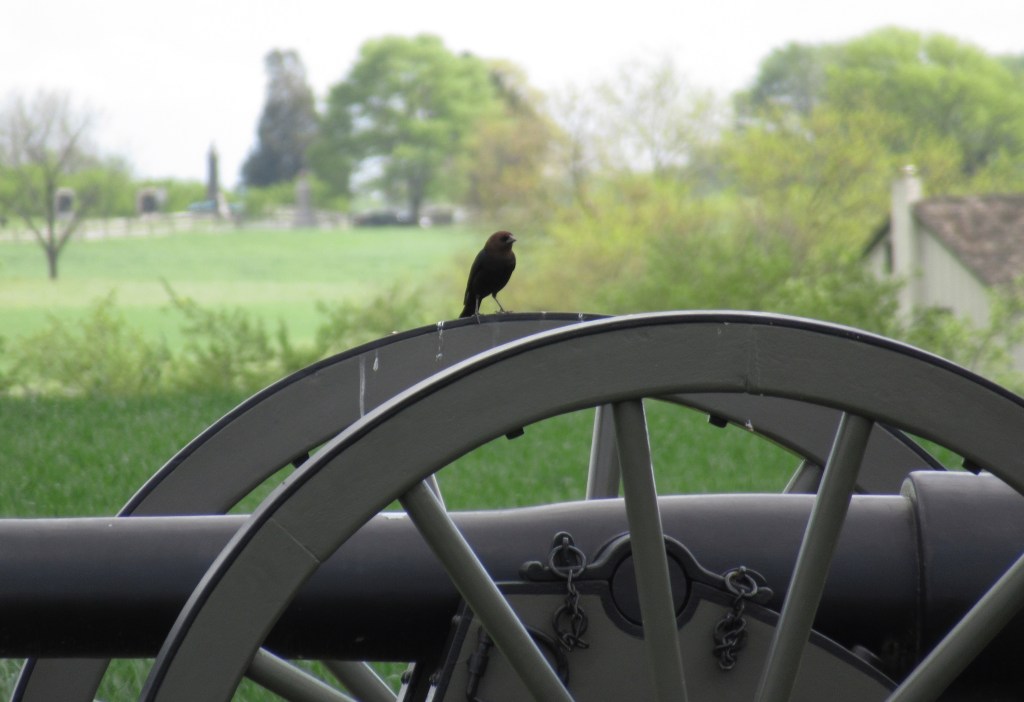
Since I was a little boy growing up in Southern California, Gettysburg has been a point of fascination and awe for me. It was a turning point in the Civil War. That’s where President Lincoln gave one of his most famous speeches. Anybody with an interest in American history wants to visit the site. And now, for the first time in my life, I got to spend a day there. Gettysburg is only 79 miles from home.
The Visitor’s Center houses a Museum, Theater, Cyclorama, Café, and super-important for us . . . the Bookstore.
First on the to-do list was an introductory film, which was brief, but well done.

The museum itself was fascinating. It started with the events leading up to the election of 1860 and the secession of the Confederate States, then transitioned to the battle itself. I must admit that some of the quotations, images, and artifacts were quite disturbing. I don’t think I’ll ever understand why people justified slavery and the horrendous mistreatment of human beings.

Cycloramas used to be a popular way for people to experience art “from the inside.” Originally created by an Irish painter in 1787, they became popular in the 1800’s. The intent is to allow viewers to be surrounded by the images as if they were standing in the middle of the actual location. The Gettysburg Cyclorama accomplishes this so well.
After the museum and the Cyclorama, we got a drink and a snack from the Battlefield Café, and then spent some time exploring the bookstore. We love books and we love learning, so this was special for us. The store also has clothing and souvenirs.
And then on to the battlefield tour itself. We like going at our own pace, which is almost always slower than if we were in a guided tour. The reason we are slower is not because we are slowpokes. Oh no. We can keep up with anybody. The reason we prefer to go at our own pace is because we want to learn more and see more. OK, let’s be totally honest here . . . LINDA is the one who wants to learn more, read more, see more, do more. The woman can’t get enough information, knowledge, and detail.

So, we did the self-guided audio tour, using the Gettysburg National Military Park app on her phone. It’s the exact same information and videos available on the park’s website. The park ranger featured in the videos is Ranger Christopher Gwinn, Chief of Interpretation and Education, and he was fantastic.

The last stop on the driving tour was the Gettysburg National Cemetery, and is definitely worth visiting. This is where President Lincoln gave “a few appropriate remarks.” Interestingly, he wasn’t the main speaker that day. The primary orator was Edward Everett, a nationally known speaker who spoke for over two hours. Later on, he wrote a letter to President Lincoln, saying that he wished he could have accomplished in two hours what Lincoln had done in two minutes.
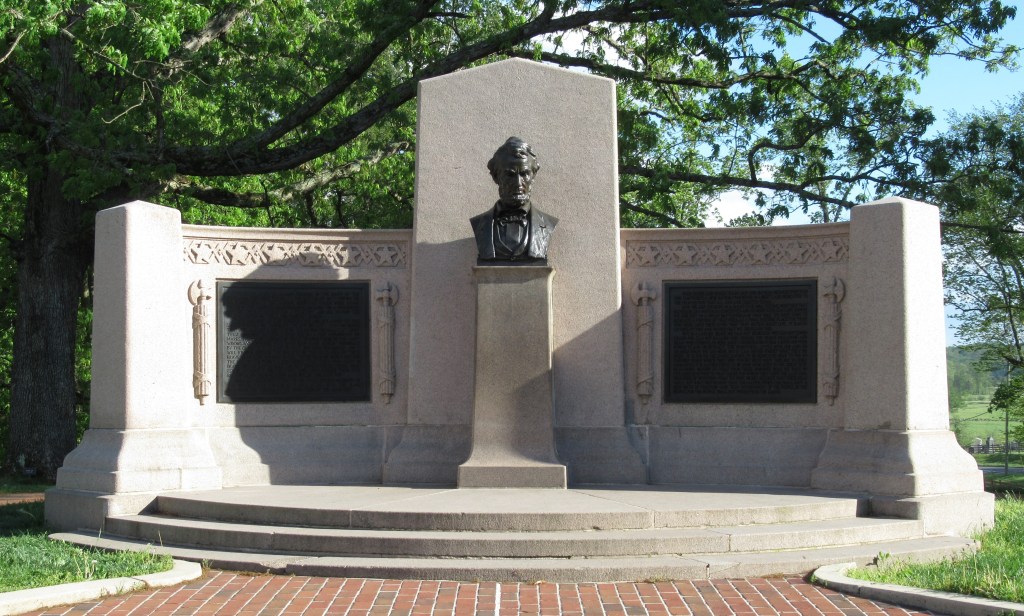
When the tour was over, we got to choose from among several interesting restaurants. We selected the Dobbin House, and enjoyed a delightful candlelight dinner, the highlight being the Date Nut Bread. Yes, we brought a loaf home.

During our meal, my wife asked her typical question: What was one of the most meaningful experiences of your day? I’ve been on her famous study abroad trips to England, so I know she asks her students that very question at the end of every day. My answer on this particular day in Gettysburg was twofold. First, the absolutely horrible attitude that slaveholders had about their African American “property.” Second, being on the battlefield and seeing the terrain and the distances.

We plan to return to Gettysburg in September to continue to experience and learn a little more. Or maybe a lot more. One day merely whetted the appetite.



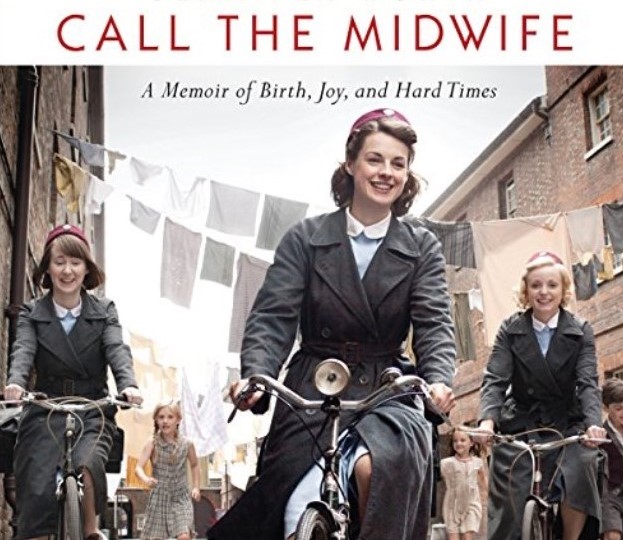 Last night, my wife and I watched another episode of the BBC television show, “Call the Midwife.” In this segment, the doctor had to be away from the office because of an emergency, and his wife, who functioned as the receptionist, was running the clinic. When the patients realized the doctor was gone, they refused to let her help them because they were totally unaware that she had worked as a nurse for ten years. In their eyes, she was “only a receptionist” and they bolted for the door until a doctor or nurse was there. The next morning, the “receptionist” was dressed in a nurse uniform, and when she opened the door to let the clients in, they saw her as a professional medical caregiver, and accepted her expertise. Even though she was the same person, respect came with the right uniform.
 Every life is a series of stories, and each person an endless repository of action, emotion, and relationship. One of the goals of literature is to capture that collection of raw material, and frame the narrative in such a way that those who read the finished product are invited to participate in a vicarious experience. If the stories are told well, readers can feel pain, joy, love, fear, or wonder. They are able to cry when a lover is betrayed, cringe when the hero of the story is under attack, or crawl under a blanket and hide to escape being discovered by the intruder.
 When we drove up to the historic motel on Route 66, an old Chevy parked out front caught our eye. It had to be more than sixty-five years old, and though the paint was faded, worn-off, and rust-eaten the car still exuded a certain charm and beauty. A couple of the tires were flat and one window was permanently open. Yet, it had a stately dignity that spoke of a time when it ruled the road.
 Paul Linzey