Training Ukrainian Chaplains

Trip Report for June Visit to Ukraine

Dr. Paul Linzey
My recent trip to Ukraine exceeded my hopes and expectations. In fact, it was one of those ministry projects that you know you’re supposed to do, but you don’t know all that is involved or exactly what the Lord is up to until you’re in the thick of it. I knew I was invited to teach chaplains and pastors at the Poltava Theological seminary Monday through Friday in the afternoon, and that my associate, Dr. Sharon Ackerman would teach in the morning on the same days. What I didn’t know—in fact, nobody knew until the circumstances presented themselves—is that I would be speaking to pastors, chaplains, military leaders, and community representatives in six different locations. I expected this to be an amazing week of ministry in the classroom, but it turned out to be much more than that. This was a powerful, life-changing experience that took place throughout the nation of Ukraine.

Dr. Ackerman’s topic for the week was Medical Ministry, and included issues like trauma, injury, PTSD, compassion fatigue, and depression. She taught on personal healing, spirituality, and the consequences of war, and how it impacts the individual, family, and community. Her interpreter was a local pastor who is brilliant and talented in her own right. The presentations were so good and rich that I wanted to stay and learn from Dr. Ackerman.

New Life Church and the Poltava Theological Seminary

My sessions centered on Chaplain Ministry During Wartime, and included issues such as critical incident response, temptation, loneliness, and the inner struggle we all face when we’re in danger. The dual focus for both Sharon and me was to help the pastors and chaplains effectively manage their own thoughts, emotions, spirituality, and responses to war and then be able to minister to their soldiers, parishioners, and family members who are also impacted by the war. We discussed the fact that the chaplain is a voice of hope, strength, and sanity. And at all times, chaplains represent their government, their church, and in a very real way, their God.
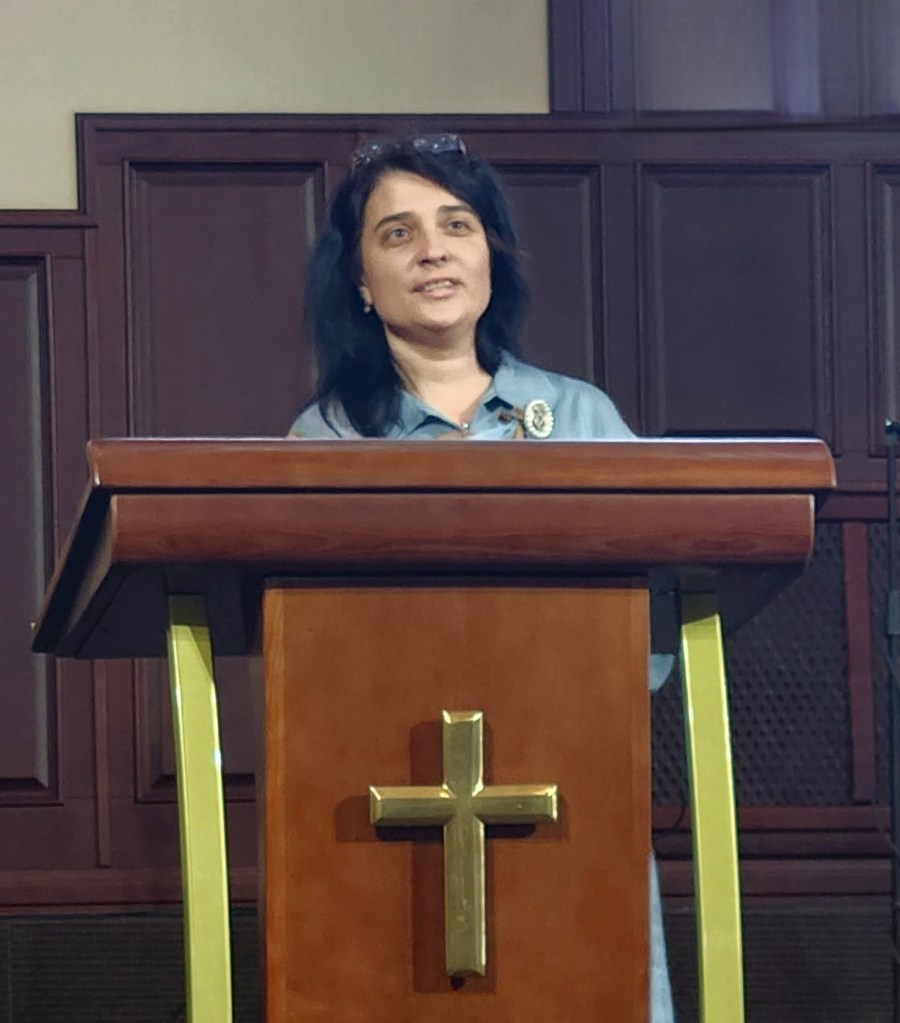
My interpreter was Sofiya Schug. I met Sofiya when I preached at the United States Naval Academy last January. She is the lead soprano in the USNA Protestant Chapel Chorale, with a beautiful, powerful voice. When the pastor introduced me as the guest speaker, he mentioned that I would be going to Ukraine. After the service, Sofiya came up to me and told me who she was: a multilingual Ukrainian-American, married with children, and a professionally trained singer. After hearing about our mission to Ukraine, she felt a strong calling to go and help in any way needed. Sofiya became a true friend and served as my interpreter everywhere I went. She was a tremendous asset to our work in the classroom, in remote locations, and while traveling.

Sharon, Sofiya, and I flew into Krakow, Poland, where we visited Auschwitz, Birkenau, and Schindler’s factory. What a way to get into the mindset of oppression and living in a war-torn country! Then, we took a bus to Lviv, followed by an overnight train to Poltava. Igor Skripnichenko is the president of the Poltava Theological Seminary. He met us at the train station and took us to our hotel. That night, we had dinner with him and his family. They have become dear friends.

My overall assessment of the ministry, the experiences, and the Ukrainian people is that this was definitely a lifechanging experience and that, the Lord willing, I will go again. It was incredible to minister and fellowship with pastors, chaplains, and community leaders. Being able to see and talk with volunteers at the seminary, the churches, and the youth group outreach team was priceless. But let me tell you about some of the special moments that occurred during my time in Ukraine.

I started one of the sessions talking about some of the items I always had in my duffle bag when I was in the Army. The first thing I pulled out of my bag was a roll of toilet paper, explaining that in the Army, you never know where you might end up on a given day, and whether there’ll be any toilet paper in that location. One of the chaplains in the back of the room raised his hand and said, “There’s none where I am serving right now.” When I football-passed the roll of TP to him, he caught it, and the other chaplains broke into applause. I took several band-aids out of my bag and said I always carried a dozen or so bandages in my shoulder pocket whenever I went out with soldiers. One pastor who is a volunteer chaplain, called out, “I cut my finger pretty bad this morning, and nobody had any bandages. I’d like one.” So, I gave him a couple of band-aids. When I mentioned that I always traveled with a flashlight, one of the chaplains said he needed one. I proceeded down the list of several more items. Then I started teaching. When the day was over, the guy who got the bandages came up to thank me, showing me his finger nicely wrapped, and that the bleeding had stopped.
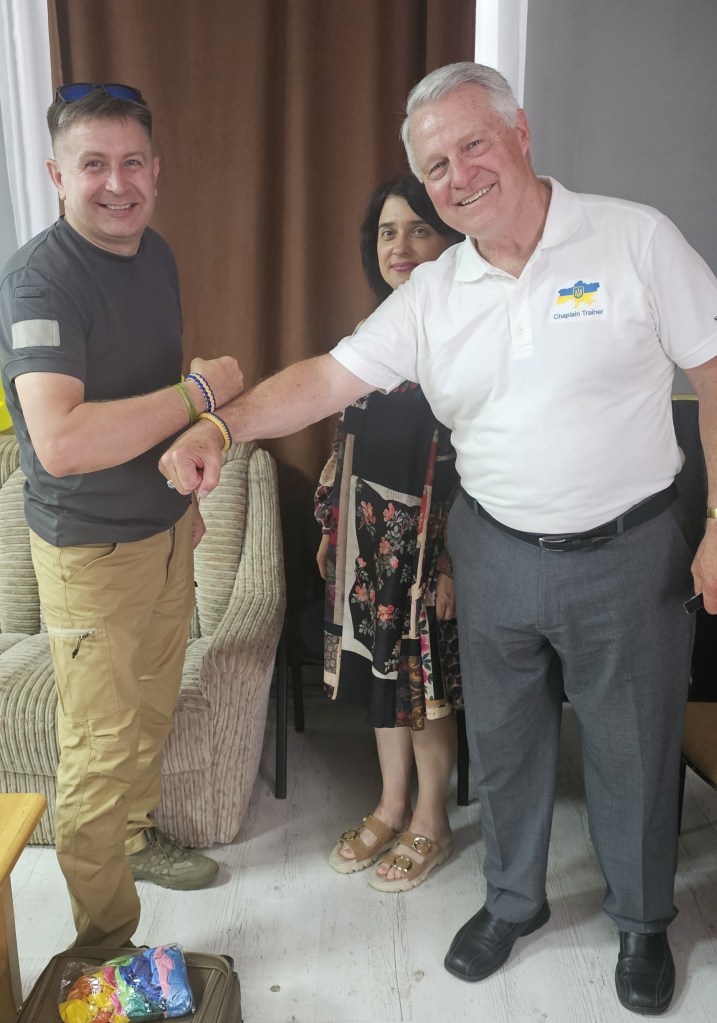
One of my sons creates handmade wrist bands and other items out of nylon 550 cord. When he found out I was going to Ukraine, he offered to make a few things to give out to the chaplains. So, I took five wrist bands, three key fobs, and a lanyard: all made out of blue and yellow paracord, the colors of the Ukrainian flag. I gave away two items per day, and after one of the sessions, a chaplain came up to me, threw his arms around me, ripped off his army patch and handed it to me, saying, “This is not for you; it’s for your son.” Then, because I wore a blue and yellow wrist band all week, one of the other chaplains who got a wrist band, wanted a picture of the two of us giving a fist bump and showing off the Ukrainian colors on our wrists. I think they liked the handmade items almost as much as the content of our teaching. In any case, it didn’t take long to develop a rapport and a love for one another as we delved into the topics for the week.

I told stories from my own war-time ministry experience in Iraq, plus a few of my father’s experiences during World War II. I discussed ministry priorities and gave them an assignment. By the end of the week, they had to turn in a list of their church’s priorities, the priorities of the Ukrainian Chaplain Corps, and their own personal ministry emphases. I mentioned the priorities that guided my work: the four ministry priorities of my church, the Assemblies of God; the priorities of every military chaplain in the United States; and my own ministry emphases. By the end of the week, they all had researched and memorized their own priorities. I have a picture of the entire group holding up their assignment.

I brought up the fact that as pastors and chaplains, we cannot afford to be impressed or intimidated by rank, wealth, fame, or celebrity because to the degree that we are impressed or intimidated, we lose the ability to minister. We represent the highest power, the King of Kings, the One who outranks everyone, and we have the responsibility and the privilege to care for and speak into the lives of people at all levels. That was a fascinating discussion.

One of the sessions focused on the need to trust God for miracles. We all are limited in what we can do, and when we reach the end of our abilities, we depend on the Lord to demonstrate his presence, answer prayer, change lives, and intervene in our circumstances. Then I showed a 7-minute segment of “The Ten Commandments” movie. When Pharaoh’s army pinned the Israelites against the Red Sea, the Lord told Moses to stretch out his staff and the waters separated, allowing the people of God to walk across on dry ground. Sometimes we find ourselves in circumstances beyond our control. It looks like we are out of options and all is lost. That’s when we have to trust God for the miracle.

A few months before going to Ukraine, I got a phone call from a man in Arkansas. He attends the church where my nephew worships, and my nephew had mentioned me at his church, asking them to pray. This man had pastored a church in Ukraine for ten years before COVID, and still has a heart for the people there. While he was praying, the Lord spoke to him. “The people of Ukraine are fighting two wars: a military war and a spiritual war. It is important that they win both wars.” He asked me to share that message with the pastors and chaplains in Ukraine, and I did. After I told the class about this Baptist pastor in the United States who was praying for them and what he had heard from the Lord, one of the chaplains in the class exclaimed, “That’s exactly what the Lord said to me when I was praying a few days ago!”

I did a session on team ministry and the need to be ready for anything. Then I had them do a couple of team-building activities that led to further discussion in small groups. I tell you what, these men and women are anointed by God, hungry to learn from the Word as well as from practical hands-on ministry. They are making a huge difference in the lives of their soldiers, parishioners, and communities.

At the end of the first day in the classroom, Igor told me that some of the chaplains weren’t able to attend the sessions because of the war. Then he asked if I would be willing to go out to where they were. “Well, it depends on where they are,” I replied. He assured me that it would be safe. And since Sharon agreed to take on some extra teaching sessions, the next day we drove out to where the chaplains were serving with their soldiers.

We showed up at a remote army base where two chaplains, five nurses, and about thirty-five morale officers were graduating, having finished their military training. I was the commencement speaker, with Sofiya as my interpreter. However, before I spoke, Sofiya sang the national anthem. She took everyone by surprise. Nobody imagined there could be a professional opera singer out there. And nobody expected the passion, the energy, and the rousing rendition of their song . . . in their language. The next several places we went, we started with Sofiya singing, and you could feel the emotion in the room, the pride, and the instant openness to whatever I had to say.

After lunch, we drove to another base where we met another thirty-five or so chaplains. As in most groups, some were active duty and many were pastors serving as reserve chaplains. I taught some of the same material I covered at the seminary because these chaplains were originally scheduled to be in the class in Poltava.
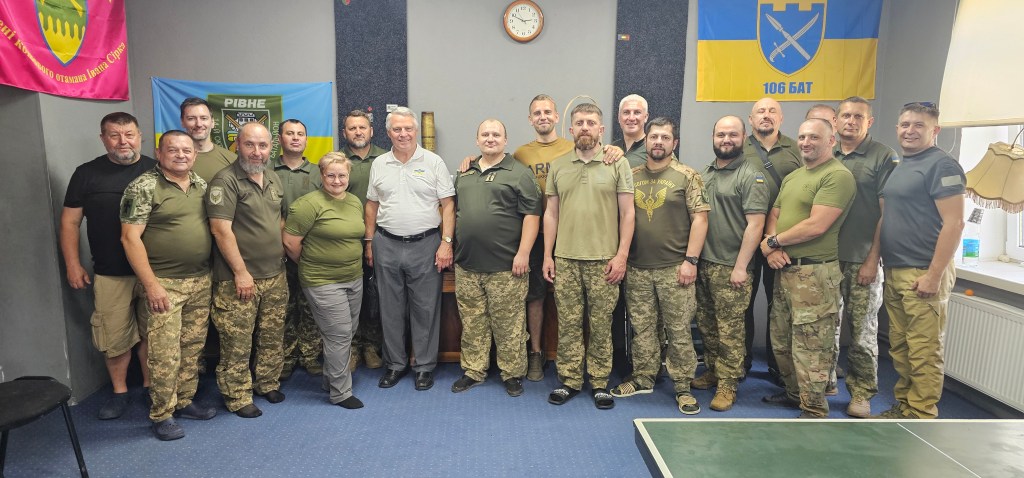
Between sessions, Igor introduced me to the senior Protestant chaplain, who explained one of the reasons he was glad I was there. According to his story, the week prior to my arrival, the lead Orthodox chaplain had told him, “I’ll wager a case of our finest kvas that the American chaplain doesn’t show up. Nobody comes out here.” The Protestant chaplain accepted the bet. Then they waited. When I walked into the room, I didn’t know why several of them had a funny look on their face, but now I knew. My new friend was looking forward to receiving a case of his favorite beverage!

As we talked, he mentioned that the military chaplains and churches of several nearby nations had come with clothing and other essentials for the pastors and chaplains to distribute. I heard him say “Latvia” and the name “Elmars” when he was talking to someone in Ukrainian, so I asked Sofiya to interpret for me.

“Are you talking about Elmars Plavins in Latvia?” I asked.

“Yes. How do you know that name?”

I met Elmars Plavins in 2007 when I was an Army chaplain in Iraq. He is the Latvian Chief of Chaplains, pastor of a large Baptist church in Riga, and was at my FOB in Iraq to visit his soldiers. The next year, I arranged for him to come to America to visit the Pentagon, our Army Chief of Chaplains, our chaplain school at Fort Jackson, South Carolina, and several other locations. This Ukrainian Protestant chaplain said “Elmars is my best friend!” and pulled out his cell phone right then and there for a video call to Latvia. I got to talk to my friend, Elmars, who I hadn’t seen since 2008.

When we got into the car, Igor told me that whenever he’s out in this region, he makes a point of visiting a pastor who lost three sons in the war. Would I be willing to meet him?

Pastor Oleksandr welcomed us to his office, and we chatted a while with Sofiya interpreting. Then he offered a tour of his church. A beautiful building that had been an opera house before the war, the place had been badly damaged, but he and his congregation have been refurbishing and rebuilding so that now it is a beautiful house of worship. Because the war has devastated the area, most of the residents are poor, hungry, and in need of assistance. Many don’t have water. The church dug a well and invited anyone in town to come get water whenever they want. There were two men filling containers when we drove up. The church collects clothing and supplies from various places in Europe and offers it to the people in town for no cost.

As we walked through the building, we came to a gymnasium where the youth group was playing volleyball. The pastor told me they were preparing for a community outreach to the teens and children in the city. They would personally deliver food, clothing, water, hope, and the love of Jesus. I was so moved that I decided I would find a sporting goods store and buy a matching blue, yellow, and white volleyball (Ukrainian colors) so that every time I see it, I am reminded of Pastor Oleksandr, his family, the youth group, and their impact in their city. That volleyball is my prized souvenir.

As we were driving back towards Poltava, suddenly Igor stepped on the gas and went much faster. He explained that he received a text alert that missiles and drones were coming into the area, and that everyone should find shelter or leave as fast as possible. Sofiya in the back seat exclaimed, “Look!” I looked out the window and about two hundred yards to my right was an explosion. Whatever it hit was quickly burning to the ground. “See those cars out in that field?” Igor asked. Those are Ukrainian drone operators who are shooting Russian missiles and drones out of the sky.” He drove a little faster. We had dinner in Kharkiv on the way home.

The next day, I taught at the seminary in Poltava. I got to check on Sharon, who was doing fine. She loves teaching and preaching, and said it was going very well. Then Igor asked if I’d be willing to go up to Kyiv. We left early the next morning. Sofiya sang and then interpreted for me as I spoke to a group of about a hundred chaplains and pastors.

When Friday afternoon came, we had an end-of-class celebration and ceremony with hugs, handshakes, and fist bumps as the chaplains prepared to go back to their soldiers fighting the war. Igor asked me, “Are you ready to go to Dnipro tomorrow? There’s a group of government representatives and community leaders who meet on Saturday to discuss the post-war reconstruction of Ukraine, and I’ve cleared it for you to be our speaker.” Sofiya sang, then I spoke on the need for the entire community to work together to rebuild and heal the land, the institutions, and the people. I told them that a community-wide response would be essential for the post-war reconstruction and healing, and that the community-wide response necessarily includes pastors and congregations because they have a built-in network with so much to offer. Then we had lunch with several dignitaries before returning for one more night in Poltava.

That night, I turned out my light and was not yet asleep when I heard an explosion. Then there were several more. I thought to myself, “The blasts seem to be about two miles away.” I went out to the hall, and people were going down the stairs to the shelter. Sofiya came out of her room and told me she had talked to Igor, who said there were five explosions about three kilometers from the hotel. There were no human casualties. He texted me and asked if I wanted him to take us up to Kyiv immediately. But by then, we received the “all-clear” message so I decided to wait until morning, as originally planned. Sofiya and I did go down to the shelter for about half an hour, mostly out of curiosity on my part. I wanted to see it.

Our train was leaving late Sunday night, so Igor had arranged to be our tour guide for some sightseeing in the capital city. It was beautiful. I got some great pictures. The war seemed so far away and life went on as usual. Sofiya had grown up in Ukraine, and the church she attended twenty-some years ago was just a few blocks from where we parked. She walked over to the church and met with some friends. When Sharon and I got on the train that night, Sofiya stayed in Kyiv to visit family and friends a little longer.

I felt like I was leaving part of my heart in Ukraine. Either that, or my heart was starting to turn blue and yellow, the colors of the flag. As I returned to America, I reflected on the new relationships I had with Igor and his family, with Pastor Oleksandr, whose church was making a difference in their community, with the many pastors and chaplains I had interacted with, and with the military leaders I had met. And I wonder: what does the Lord have in mind for the future. Will there be an open door for further involvement? I hope so.

The leadership at the seminary, the churches, and the military have asked me to return. Igor wants me to help by teaching and developing curriculum at the seminary. The military asked me to help shape some courses for the National Military Academy. They want to know if my book on military ministry can be translated into Ukrainian so they can model their programs after it. And they inquired about the possibility of my overseeing a sequel focusing on chaplaincy in the Ukrainian Armed Forces. Several pastors invited me to come back and preach in their churches. And I already feel called to encourage and train pastors and chaplains.

But I am keenly aware that this was only possible because of the kindness and generosity of some wonderful people and churches who supported this project.

Pastor Phil Schneider is the Superintendent of the Illinois District of the Assemblies of God, where my wife and I are ordained and serve in ministry. Pastor Phil has been very supportive and directed his staff to provide assistance. The media director created and edited the video introducing the project. The business administration staff set up the account for tax deductible donations.

Several churches allowed me to give a presentation to the congregation. These include Hobson Road Community Church in Downers Grove, IL; Trinity Assembly in Sharpsburg, GA; and The Grove Community Church in Altona, IL.

Two organizations that gave generously to this project were the Mark and Rachel Bailey Charitable Fund and P & L Publishing & Literary Services. In addition, many friends and family gave through the spotfund campaign or sent money directly to the IDCAG account.

I want to thank all of you for your kindness. Thank you for praying. Thank you for your love and friendship. Thank you for making it possible for me to go, to have this experience, to make a difference for people in some pretty scary circumstances. Together, we made an impact on behalf of the Lord and his church.

The colors of the Ukrainian flag represent blue sky and golden wheat.
As we were driving one day, Igor stopped so I could take this picture

Training Ukrainian Chaplains

Because of political turmoil and the war in Ukraine, this is a critical moment in Eastern Europe. Recognizing the need for pluralistic chaplain ministry in its armed forces, the Ukrainian military created a brand-new chaplain corps that was approved by the government in 2022 and officially started in 2023. Ukrainian leaders are now looking for outside help to train and educate their chaplains.

Video Link: Click here to Learn More

There’s a Theological Seminary in Poltava, Ukraine with an outstanding reputation and the military has asked the school to provide training and education for their chaplains. The seminary reached out to the Chaplaincy Department of the General Council of the Assemblies of God to help provide that training, and they asked us to put a team together.
The seminary is asking for a three-year educational training plan that will encompass theology, practical aspects of military chaplaincy, and specialized topics that will prepare clergy for what they may experience as military chaplains in Ukraine.

Our team is prepared to teach and train Ukrainian chaplains in a wide range a specialties and skills.

The Armed Forces of Ukraine has committed to send their chaplains to the Poltava Theological Seminary for six classes per year for the next three years. With our experience and expertise, we can provide what their chaplains need, but because of the war, they can’t pay our expenses to get there.

And they don’t have the means to purchase or create a curriculum. This means we have to raise the money, and we estimate that it will take $24,000 per year to train the chaplains.
This will cover our travel expenses, classroom materials and supplies, and the curriculum that we will prepare and leave with them for continued use. After three years, they will have enough chaplains complete the program that it will then be self-sustaining and our job will be done.

The long-range goal is to raise $72,000 for a three-year training cycle, but our immediate goal is to raise $24,000 for the first year. Contributions are tax deductible through the Illinois District of the Assemblies of God.

The motto of the chaplains of the Armed forces of Ukraine is “Being There.” That is their mission, and they are fulfilling that calling even through some pretty tough situations and bleak conditions.

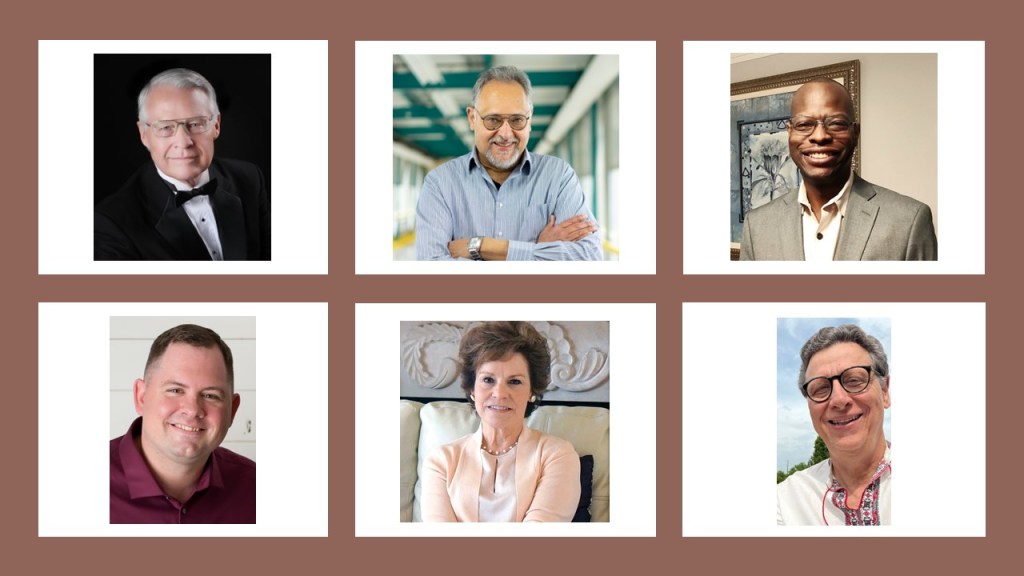
Top Row Left to Right: Paul Linzey, Manny Cordero, Vince Lambert. Second Row Left to Right: Josh Andrew, Sharon Ackerman, John Michno

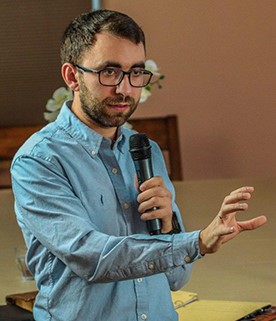
John Michno completed the MDiv at Fuller Theological Seminary and became a military chaplain. After retiring from the military, he pastored in Ukraine and Russia. He is Ukrainian American, speaks Ukrainian and Russian, and is a missionary with the National Slavic District of the Assemblies of God.

Dr. Sharon Ackerman is a hospital chaplain with experience as an educator, pastor, sociologist, and missionary. She has worked for human rights and religious freedom for women and persecuted Christians, and is the author of several books. She has graduate degrees in religion and sociology and two law degrees from Cornell Law School.

Joshua Andrew is a former Army chaplain. He has served over 17 years as a pastor, educator, and a military chaplain in both combat and humanitarian roles. He holds an MDiv in Theology and a PhD in Education.

Dr. Manuel A. Cordero is the Senior Director for U.S. Chaplaincy Ministries for The General Council of the Assemblies of God.  He has been in chaplaincy ministry for more than 44 years, originally working with the Federal Bureau of Prisons for nearly 24 years.

Vince Lambert is a senior military chaplain who spent a year in Ukraine training volunteer military chaplains. He has an MDiv with additional graduate work towards a DMin, and is the author of the devotional book, 30 Days Ablaze.

Dr. Paul Linzey is a retired military chaplain with war-time experience. He has trained U.S. and international chaplains, and now teaches at a Christian college. He has written two books about chaplain ministry.

John Michno and Paul Linzey are co-team leaders for this project.

It didn’t take long after Russia invaded Ukraine for the Ukrainian government and military to realize they needed full-time, professional chaplains in the Armed Forces of Ukraine. Historically, Ukraine depended on volunteer clergy to serve the military. This is a huge development. But along with it came the decision to open the chaplaincy to clergy from multiple faith groups, so they are moving towards a new pluralism and diversity.

Now that the foundation is in place, the next step is to provide the professional training and education the chaplains need, which is why they reached out to the Poltava Theological Seminary, who in turn asked us to partner with them for three years.

Our team has the education, the experience, and the expertise to accomplish this mission. What we need is the financial backing of people who care, who understand the immediacy of the open door in Ukraine, and who want to do something about it.

Igor Skrypnichenko is the Vice President of the Poltava Theological Seminary. Because some of his graduates are now chaplains doing great work among soldiers, he has been asked to train new chaplains. It is largely because of Igor’s compassion, excellence, and tireless hard work that he has developed a rapport with Ukrainian leaders, and why they want him to head up chaplain training. But just like the rest of us, Igor has only twenty-four hours in a day, and is spreading himself too thin.

When Igor reached out to the Chaplain Department of the Assemblies of God, they asked John Michno and me to put a team together. As you can see above, the chaplains we have assembled for this project are outstanding.

There are several ways you can help us. First is to pray. The war is still going on, and February 2024 will begin the third year of the current conflict. Pray for peace. Pray for the people who have lost everything. And pray for safety, wisdom, and discernment for us. Another way you can help is to support us with your giving. We are preparing six classes per year. Each class requires a teacher to create the curriculum, travel to Ukraine, and provide materials and supplies.

You may send donations by mail to:

Or give online at IDCAG.ORG. You are welcome to designate a donation to me or specify any member of the team. You may also give an undesignated contribution that we will share.

Thank you so much for your generosity. We really cannot do this without your help.

Abandon Ship!

I was a young sailor on June 4, 1942, when the USS Yorktown was sunk in the Battle of Midway. We were only three miles from land—straight down! And that is where our great aircraft carrier still rests today as a tomb for some eighty-six of our friends whose lives so suddenly ended on that tragic day.

The best of the American and Japanese navies were in full conflict at the Battle of Midway, and we already had taken three bomb hits. Our hangar deck was in flames from one bomb, another had set fire to our fourth deck, and a third had exploded in the stack and blown out the fires in our boilers. We all felt the ominous silence of dead engines as we floated lifeless in the water!

At 2:00 P.M., our engineers had just gotten the ship’s engines started again when the next wave of Japanese attack planes came roaring in and dropped their torpedoes for the kill. That was more than a half century ago, and yet I can hear the agitated voice that spoke over the headphones and loudspeakers as if it were yesterday: “Stand by for torpedo attack!”

I can still close my eyes and shudder at the memory of the thudding of the two torpedoes as they struck us on the port (left) side. I was down on the third deck at water level when they blasted the side of our ship and ripped huge holes in our hull, and I can still remember how the ship lifted into the air with the impact of the explosions. As the water rushed in, the great aircraft carrier listed to the port side at twenty-seven degrees until the very edge of the hangar deck was dipping into the water. Inside the ship, there was nothing like a deck or a bulkhead, for every surface was lying at an angle and making it almost impossible to maneuver from one compartment to another. Water mains were broken and were spewing forth water, and the lights were out. Only the blue battle lamps illuminated the scene.

I will never forget the last command of Captain Elliott Buckmaster. A chill went through all of us as we heard his fateful words: “Abandon ship!”

In the following hectic hours, we struggled for survival. We had little time to think of the many friends we were leaving behind in the depths of the ship. If we were having trouble with a loss of electricity and broken water lines at the third deck, surely the men below us were flooded with little hope of survival. Yet, in spite of the jeopardy of our condition, I recall the disciplined calm among our sailors as we worked our way up through the destruction. Well trained for such a calamity, we helped each other find our way to the surface and then slid down two-inch lines into the oil-covered sea.

History has recorded the battle strategies, the mistakes, the glories, and the tragedies of the war at sea. The Battle of the Coral Sea, in which the Yorktown was first damaged, turned back the southern expansion of the Japanese Empire; the Battle of Midway, where she was sunk, was the turning point of the Pacific War. We look back now and see the entire Pacific Theater of the war from beginning to end—the Japanese expansion in Asia and the Pacific Islands, the attack on Pearl Harbor that brought America into the war, the prisoner-of-war camps, the raising of the U.S. flag on Iwo Jima, the atomic bomb attacks on Hiroshima and Nagasaki, and the signing of the unconditional surrender on the deck of the battleship USS Missouri. Much has been said, written, and documented on film, but what history does not remember is that wars are not composed of the grand battles alone but of the personal challenges, tragedies, sacrifices, and faith of individuals caught up in the greater conflict.

History does not remember that at the very time when the survivors of the Yorktown were fighting for their lives, in the thick oil slick that surrounded the sinking vessel, many individuals and churches in America were praying. My own wife was seized with a deep burden for prayer, and just before the battle, I had one of the most outstanding spiritual experiences of my life. To all that has been written, I am adding my voice to say, “God was at Midway!”

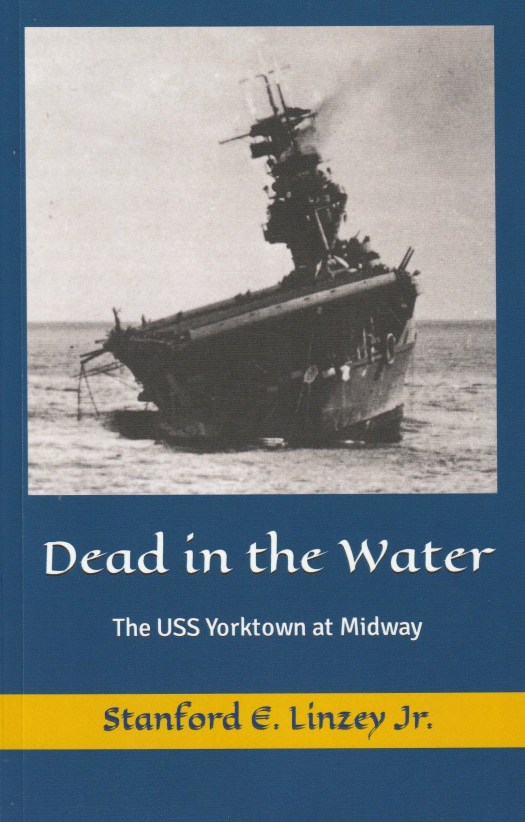
This is an excerpt from the book, Dead in the Water, written by Stanford E. Linzey, and republished with a new introduction by my brother, S. Eugene Linzey, and an afterword by me. It is available on Amazon and on this website. The painting of the ship is by contemporary artist, Richard W. DeRosset.

USS Yorktown: The Fighting Lady

Built from 1934-1936 and commissioned in 1937, the USS Yorktown was involved in some major battles in WWII and received the nickname . . . The Fighting Lady. There were four announcements that the crew of 2,217 sailors and about 300 aviators didn’t want to hear.

1. “Battle Stations!” That meant they were about to enter combat.

2. “Fire!” This didn’t mean to shoot at anyone. It meant there was a fire on board the ship. The ship was home, and there was no front or back door to leave a burning inferno, so fire was a dreaded enemy.

3. “Stand by for attack!” In battle, everyone from the captain to the newest recruit knew he might be killed.

4. “Abandon Ship!” This one was nerve-wracking because the nearest land was three miles away–straight down! And sharks were not the kind of company they preferred.

Dad was on the Yorktown each time it engaged the enemy. With headphones on, he heard the blood-curdling words, “Zeros at 50 miles out!” These Zeros, sometimes called Bandits, were Japanese fighter-bombers and torpedo planes.

“Zeros at 25 miles out. Stand by for air and torpedo attack!”

Dad’s mind raced back to the battle of the Coral Sea just four short weeks earlier. It seemed like a year ago, yet it felt like yesterday. An armor-piercing bomb hit the flight deck and sliced through three more decks before exploding in the room next to his station. It immediately obliterated 35 of his shipmates, but if it had been eight feet closer, it would have also splattered Dad.

Dad’s job was to pass reports to damage-control crews who then fought their way through the rubble and did their best to put out fires, make repairs, and keep The Fighting Lady afloat.

But he did much more than that. Through his interaction with men of all rank, he taught them how to face adversity, face hardship, and even face death with head held high and without fear. He revealed his faith in God when the world seemed to be falling apart, and shared emotional and spiritual strength through personal conviction.

2nd Class Petty Officer Stanford E. Linzey, Jr., loved the Lord, loved life, and loved people. He never hated anyone, including the Japanese. But he was a man with high integrity, and to the best of his ability, he did his job to help his country.

The above is an excerpt from the introduction to the book Dead in the Water. The book was written by Captain Stanford E. Linzey, Jr., CHC, USN, Retired. The introduction was added by my brother, Stanford E. Linzey III. I plan to post several excerpts leading up to December 7, also known as National Pearl Harbor Remembrance Day.

Pearl Harbor

I’ll never forget what he said, or the look on his face as he relived the hell of battle. Dad’s words were bathed in emotion. Hardened by the intense heat of battle, he still choked up at times as he remembered Guadalcanal, Gilbert Islands, Coral Sea, and Midway. He repeated “Coral Sea,” hesitated, breathed deeply and said, “Midway.”

Did I detect anger? Or was it sorrow?

Dad won the Texas State High School Championship as a clarinetist in the school band, then joined the navy in 1938 as a musician. In peace time he played the clarinet in the USS Yorktown Band, and the saxophone in the jazz band. But in battle he was an intra-ship radioman, assigned to the aircraft carrier, USS Yorktown CV-5.

Dad was a Texan, as was Admiral Chester Nimitz, and often told me of battles in Texas history. Sentences we read without emotion in history books became commands bathed in blood and tears when Dad said them. If you’re not a Texan, Remember the Alamo! and Remember Goliad! could mean almost nothing to you. But it sometimes brings tears to my eyes and raises goose bumps on my arms because my Dad was a Texan! No, he didn’t fight at the Alamo in 1836 or at Goliad in 1835, but he made sure that I, his oldest son, knew about them.

Dad didn’t join the navy to kill people. He didn’t even want to go to war. As a nine-year-old boy, when he had the privilege of seeing John Philip Souza on Souza’s last tour with the United States Marine Band, he was inspired and dedicated himself to music. Becoming an award-winning musician, he wanted to join the United States Navy Band. Fighting a war was not on his radar screen. However, personal plans and goals don’t always develop to our liking. In this case, Japan bombed Pearl Harbor on December 7, 1941.

The above is an excerpt from the introduction to the book Dead in the Water. The book was written by Captain Stanford E. Linzey, Jr., CHC, USN, Retired. The introduction was added by my brother, Stanford E. Linzey III. I plan to post several excerpts leading up to December 7, also known as National Pearl Harbor Remembrance Day.

The Ukrainian Stranger

My first Sunday at the FOB in Iraq was Palm Sunday, one week before Easter 2007. Eight people showed up for church that morning: a civilian I called Pastor James, four American soldiers who had been meeting with him faithfully for the past year, my Chaplain Assistant, one new guy, and me. It was easy to see that the soldiers respected James. He had been there for them, and they loved him. My sermon was based on Mark chapter eleven, “Blessed is he who comes in the name of the Lord.” We finished worship having communion together, Pastor James and me side-by-side.

After I thanked everyone for coming and was about to dismiss the small group, a stranger in a Ukrainian army uniform walked into the chapel unannounced and proclaimed, “I have something to say.”

He had an excellent command of English vocabulary, but with a heavy accent. He was an attractive, friendly man, about 6′ 2″ with short hair, heavy eyebrows, and green eyes.

“I am not a Christian. Several months ago, I started having problems with my eyes. I went to the doctors here in our medical clinic. They told me I had an incurable eye condition. They brought in a specialist who confirmed the diagnosis. He said there was nothing they could do for me. No treatment. No medicine. No surgery. He said my eyes would gradually get worse until I was totally blind. Last Sunday I came here and asked the men if they would pray for me.” He pointed to James and said, “That man put his hands on my head and prayed. These other guys put their hands on me and prayed too.”

“The next day, last Monday, I could see better, so I went back to the clinic. The doctors did the same tests all over again. This time, they said I don’t have that disease. I have been back to the clinic to see the doctors almost every day this week. Your God healed me. I am not going to lose my eyes. I am so happy. How can I become a Christian?”

You could hear the sounds of surprise and amazement from the small congregation, especially from Pastor James and the men who had prayed with him the previous Sunday. In simple terms, I explained who Jesus was and what it meant to receive him as Lord and Savior.

I wasn’t a part of the miracle of healing that he experienced the previous week. Pastor James and the others had prayed for him. But on my first Sunday at Camp Echo, I had the privilege of praying with this man, a captain in the Ukrainian army, as he asked Jesus to come into his heart. The feeling among our little group was incredible.

The Ukrainian brother came alive. Every time I saw him, whether walking down the street, sitting in the DFAC, or attending a staff meeting, he hugged me, told me how thankful he was that Jesus healed him and saved him. And then he’d say, “We have to tell people about Jesus. They have to know him.”

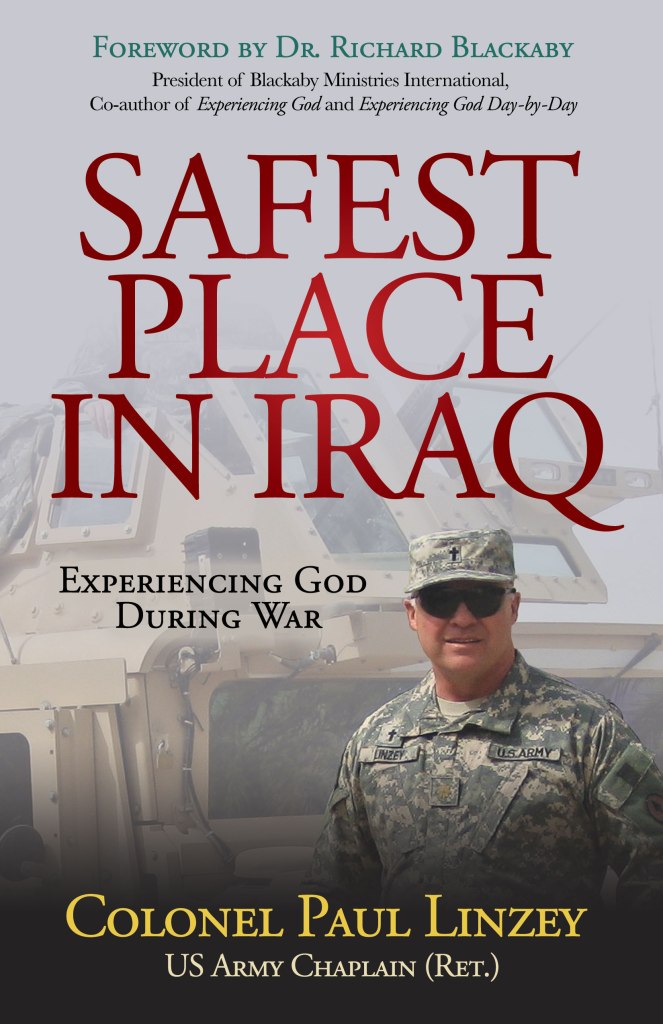
The rest of the story may be read in the book Safest Place in Iraq. You may click the Books tab above or order it through any bookstore.

Should I Give This to a Friend?

I got this email through my website yesterday:

Hi,  Paul. A friend loaned me a copy of your book and I read it. I enjoyed it, so I bought a couple of copies. My pastors wants to read it. Here’s my question: I have a friend who served in Iraq some time ago, maybe 15 years ago or more. He did lose some friends and saw action that had casualties. Do you think this book would be appropriate to offer for him to read? Would it bring some perspective or healing? Or take him back to relive the horrors of war? I would appreciate your input.

And here’s what I wrote back to him:

Hello, friend. Great to get your email. Thank you. I think the book would be a good thing for your friend to read. While it mentions some of the painful stuff and the danger, it also shows how some of us processed the PTSD and got better. The Lord is a huge part of that, and I think it could be helpful for your friend. I’ve had a chance to talk with other veterans who went through some pretty horrible experiences, and they told me it was helpful. So go ahead and share it with him, and tell him he’s welcome to give me a call or an email if he wants to talk about his experiences over there.

The man’s pastor wants to read the book, which leads me to say this: Anyone looking for a book to use for a book group, a Bible study, or a home group discussion might consider using Safest Place in Iraq. There are discussion questions in the back. Plus, there’s a separate study guide. Consider using it in your group or at your church.

Publisher’s Virtual Book Launch

I am so excited for my publisher’s Virtual Book Launch event for their fall 2020 catalog of new books. The book launch week of November 16-20 will be an incredible celebration of sharing author interviews and conversations with the world!

The event will be hosted on www.MorganJamesBookLaunch.com. Each day of the week, November 16-20, will spotlight a different theme. My book is included in the “Get Lost in a Good Story” category, and will be featured on the website at 3:00PM EST on Tuesday November 17th.

Leadership Podcast Interview

Dr. Richard Blackaby, of Blackaby Ministries International, recently interviewed me for his Leadership Podcast. The conversation is about 35 minutes long, and covers diverse topics such as what it’s like to be at war, responding to temptation, the power of prayer, the importance of unity in marriage, being an effective witness for Christ, why some people consider suicide, and effective leadership and influence. You can listen to the interview by scrolling to the bottom right of this screen.

Richard and I were discussing my new book, Safest Place in Iraq, where, I mention the impact that Dr. Blackaby’s devotional book Experiencing God Day By Day had on me while I was in Iraq, specifically how the Lord used one particular reading on May 8 to prepare me for an amazing encounter with one of our Iraqi interpreters.

You can hear this story by listening to the recorded podcast. And you can read many more stories in the book, Safest Place in Iraq, which is available on this website or at any bookstore.

Safest Place in Iraq is a collection of inspiring stories showing what God was doing in some people’s lives during the war in Iraq. It’s perfect for individual reading, small group, discussion, or even in a classroom setting.

Feel free to contact me through the Connect page above, or by leaving a comment below, and tell me what you think.

Heat, Danger, Dust, and Death

I knew from the start that I could be wounded or killed. It was a weird feeling, and I came to accept it. How or when, I had no idea. But every time there was another explosion, I wondered if this was the day.

My wife also knew I might not make it home alive. Or if I did return, I might be a broken man – crippled, blind, psychologically damaged, or all of the above. With that possibility in mind, she told me before I left home, “I don’t want to find out after you get back or after you’re dead that you were in danger. I want to know right away.”

Many of our military personnel won’t tell their spouse and family what they’re going through during war, thinking they’re protecting them. Plus, we’re limited in what we’re allowed to say or write to our families. But I have a hunch there are many, like my wife, who are better off knowing what’s going on, and who want to know.

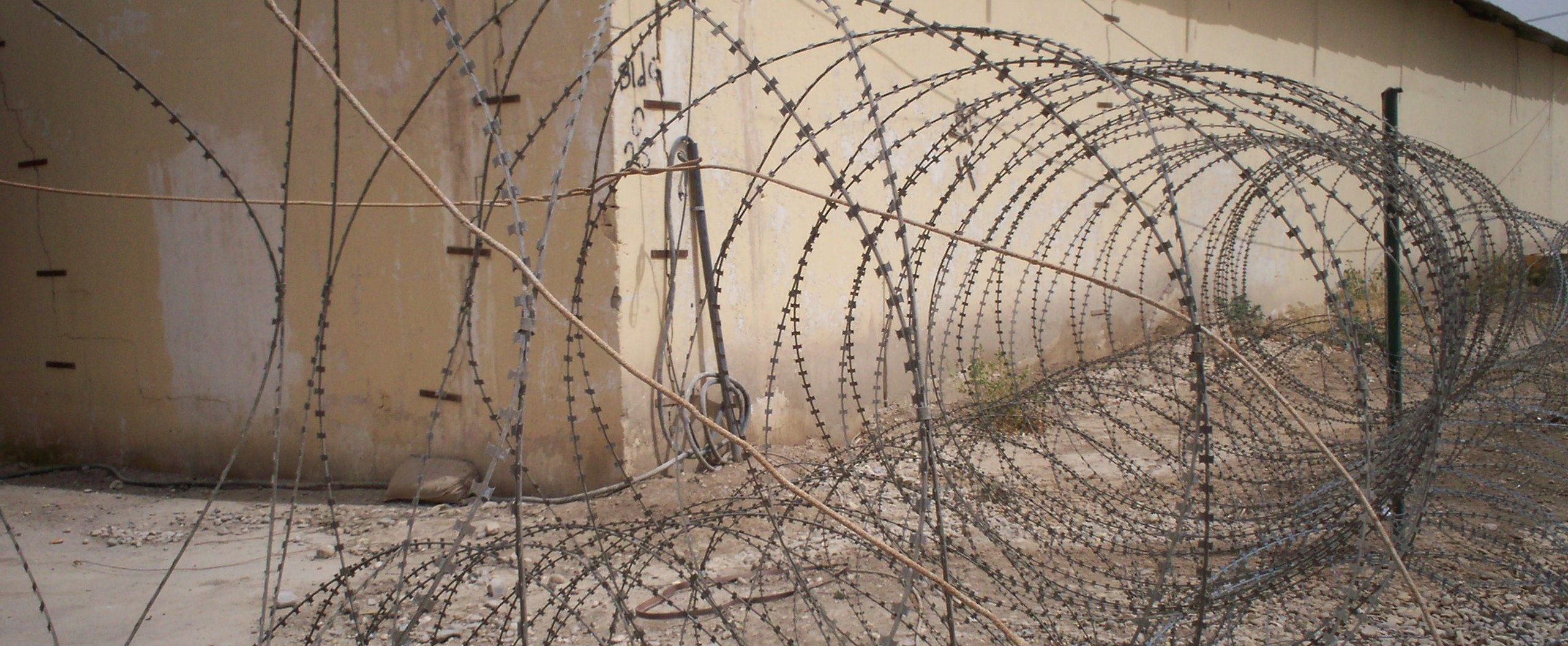
The first time I mentioned during a phone call some of the dangerous things that were happening, she said, “I already know. I saw it on TV and in the newspaper. They’re mentioning Diwaniyah and Camp Echo by name.” She scanned and sent me an LA Times article. I took it to our staff meeting the next morning, and discovered that many on our leadership team didn’t know what was going on outside the wire.

Heat, danger, dust, and death formed the context for the job I was sent to do. Operating from the philosophy that “ministry follows friendship,” I built relationships among the men and women at Camp Echo: military, civilian, American, and Coalition. This allowed me to be there when they were at their best and when they were at their worst, in their strongest moments and in their weakest.

In the heat of the battle and the heat of the desert, hours turn into days, which transition to nights, and add up to weeks and then months. The conditions wear you down, leaving an imprint on your mind and your soul: images that will be seen in dreams for months or years, sounds that reverberate long after you’re home, people you befriended and cared about and stared at death with, but will probably never hear from again. For many of us, it’s only memory now. But for others, the war continues . . . on the inside.

Picture 048 - Copy (2)