Wednesdays in Washington

When my wife and I had an invitation to take a job in Annapolis, Maryland, we thought and prayed about it, and accepted the invitation. Not only did we value the position and the work we would be doing, we also liked the idea of being near the nation’s capital.

We’ve been to Washington DC several times, but now that we’ll be living here for at least a year, we want to see as much of the area as possible. And, since Wednesday will be my day off, at least for now, that’s when we plan do our excursions. We’re calling them Wednesdays in Washington.

Our first trip to the city, we drove to the Metro station in New Carrollton, parked the car, and took the public transportation. We were stunned to find nobody else in our car. Not one other person. When we landed at the Smithsonian, we climbed the steps to exit, but I wanted a picture of the tracks below, and was surprised to find nobody there. Again, the place was abandoned. Maybe because of Covid, but it was quite strange to see a Metro station so empty.

We knew that most of the museums in town were closed, but we wanted our first visit to be at the National Mall, anyway. We were hoping there might be some cherry blossoms still on the trees, but alas, not one blossom remained. But there were three memorials we had never visited.

Walking around the basin, we came to the Jefferson Memorial. Despite the fact that it was scaffolded for renovation, it was open, and we got a chance to read about the man and his impact. His writing and speeches on liberty and freedom were probably among the greatest influences in the founding of the United States. Freedom of thought, religion, and conscience. Political liberty, education, and the equality of all people. These were some of the values and commitments he proclaimed and worked into the fabric our founding documents, laws, and policies. It’s a shame our country has taken so long to implement these concepts that were stated so long ago.

Another site we hadn’t visited was the Franklin Delano Roosevelt Memorial. FDR was president at a crucial time in history. It was a tough time not only for the United States, but around the world. The Great Depression brought poverty and ruin to millions of people, and was followed by World War II. President Roosevelt rose to the occasion in both crises and took action. One of his quotations engraved on the stone walls declared, “There should be no forgotten men, and no forgotten races.”

This allowed us to segue to the Martin Luther King, Jr. Memorial and saw the sculptor’s portrayal of MLK’s “I Have a Dream” speech: This is our hope . . . We will be able to hew out of the mountain of despair a stone of hope. With this faith we will be able to transform the jangling discords of our nation into a beautiful symphony of brotherhood. “Out of the mountain of despair, a stone of hope” is carved into the stone which Dr. King is portrayed as emerging from.

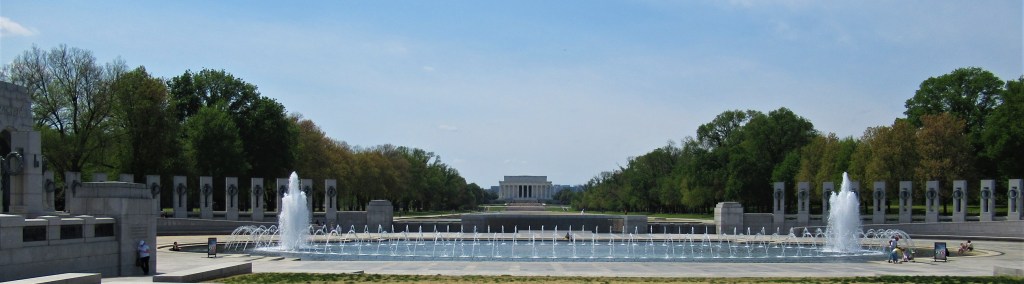
From there we walked to the Lincoln Memorial, the Viet Nam Memorial, the World War II Memorial, and the Washington Monument, talking, reflecting, and taking pictures as we walked. We had totally missed lunch, and were starting to feel the effects of not eating. Fortunately, we came across an ice cream vendor who rescued us. After resting a bit while eating our ice cream, we walked back to the Metro station and retraced our journey til we arrived back at our home. Tired, but perhaps more-informed and wiser.
Writing Challenge Winner!

I just found out that an article I recently posted won the weekly writing challenge from FaithWriters. The article titled “Running a Marathon” is an excerpt from a brand new book I’m co-writing with Dr. Keith Travis. Our book is titled Military Ministry: Chaplaincy in the 21st Century.

Some comments from readers of the article:

“I liked the idea of comparing training for a marathon for the training of everyday living. Both types of endeavors are only successful with God’s help.”

“Your article has good content and speaks of experience.”

“I really liked this! It wasn’t hard hitting, yet had a very definite message. It was great.”

“Your title drew me in, and I wasn’t disappointed! Sounds like someone that knows about running in a marathon physically and spiritually! You’re running to win!”

“This is a great devotion. I liked your real life lesson and your biblical one too.”

Running a Marathon

Nobody shows up the day of a marathon without taking the time, the effort, and the expense to get ready, because running a marathon will require months of preparation. The training has to include long distances several days a week. Eating habits need to be modified because nutrition can work for or against the body and the mind.

A marathoner will become an expert on things like foot care, clothing, and how to prevent chafing. Research will determine the best shoes for the particular shape of the foot and the unique way each athlete runs. Just as important is the training of the mind for the grueling ordeal of running 26.2 miles, because anyone who loses the mental game is already in trouble.

Another aspect of preparing for the race is being careful to stretch and warm up before every run. This is crucial in the prevention of injury. It also enables the runner to extend the stride for maximum reach, which equates to more ground covered each step of the way, and when running 26 miles, an inch or two per stride adds up, which means less time to complete the race, and a greater chance  of winning the race.

The same attention to detail must be considered when preparing for life, marriage, a career, or ministry. Putting in the time to pray, do the research, and count the cost will pave the way for long-term success. And in the same way a runner will stretch before running, the Christian will stretch and warm up spiritually every day. This is done by reading the Bible, singing a few worship songs, or spending time in the presence of the Lord. This daily “quiet time” enables you to reach a little farther each step of the way, just like stretching helps lengthen the runner’s stride. And it helps prevent spiritual or emotional injury, the same way stretching prevents physical injury. In the big picture, this daily practice will enable you to proclaim with the apostle in 2 Timothy 4:7: I have fought the good fight, I have finished the race, I have kept the faith (HCSB).

We never know what we might face in the future. That’s why it’s so important to continually add to our training, our learning, and our growing, both personally and professionally. The price of success is high, and we have to count the cost. Is it worth it? You have to decide for yourself. On your mark. Get set. Go!

Recommendation for Safest Place in Iraq

I pray that all of you are doing well after a week of glorifying God during Holy Week.  As I compose this email, I have a lingering awe over the profound power of Jesus’ resurrection . . . how that day changed everything for everybody for all of history and all of eternity . . . how it changes you and me every time we bow our heads in prayer!  God is so good!

Here is a recently released book by a chaplain:

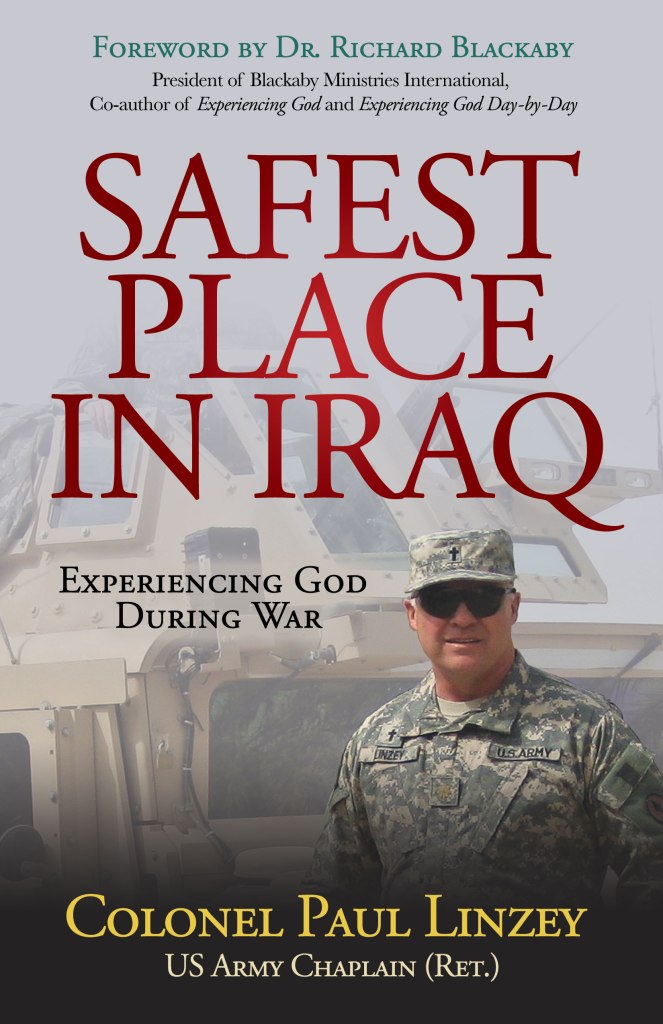
“Safest Place in Iraq: Experiencing God During War” by Chaplain Paul Linzey, is an excellent resource for chaplains, as they consider how they might handle combat ministry.  Great vignettes throughout.  Honest and inspiring.  It’s widely available and costs about $20 in paperback.  It is published by Morgan James Faith.

From Rev. Jim Denley, Retired Navy Captain, now the military chaplain endorser of the Assemblies of God. The book may be purchased on this website, from the publisher, or ordered from any bookstore.

He Ain’t Heavy; He’s My Brother

I posted this about a year ago, but it was featured on CBN.org today as their daily devotion, so I wanted to play it again on my blog.

Walking along a country road, a little girl struggles under the weight of a heavy load. A passerby stops to see if she needs help, and notices that she’s carrying a rather large baby boy, not much smaller than herself, it seems.

“Don’t you get tired carrying him?”

The little girl matter-of-factly replies, “He’s na heavy; he’s mi brither.”

The story first appeared in Scotland in 1884, in a book on the Parables of Jesus. It showed up in the September 1924 Kiwanis magazine. Then in 1941, Father Edward Flanagan discovered a similar story with a picture in Ideal Magazine, and got permission to use the motto and image at Boys Town, the home for boys he founded.

The movie Boys Town came out in 1938. A 1941 sequel, titled The Men of Boys Town, included the line, “He ain’t heavy, he’s my brother.” In 1969, Bob Russell and Bobby Scott wrote a song by the same name. It became popular and was song by dozens of pop singers in the 60s and 70s. In addition, there have been numerous paintings and sculptures on the same theme.

There’s something about the story of the little girl that captivates the imagination and begs to illustrate a key theme in the Bible. In Genesis 4:9, The Lord asks Cain about Abel, and the murderer replies, “Am I my brother’s keeper?” The answer implied in the scripture is simple. “Yes, you are your brother’s keeper.” Leviticus 19:18 instructs the people of God to “Love your neighbor as yourself,” which Jesus quotes in Matthew 22:37. The apostle Paul adds in Galatians 6:2 that we are to “Carry one another’s heavy load, and by doing so, fulfill the law of Christ.”

In Victor Hugo’s timeless novel, Les Misérable, Jean Valjean is a former criminal who changes his name and his lifestyle in order to hide his past, eventually becoming the mayor of a town. But the new chief of police is the very same officer who was a guard at the prison, and is looking to re-arrest Valjean for breaking parole. One day, one of the men in town is trapped under the heavy weight of a horse-drawn wagon, and nobody is able to get him out from underneath. Then, while Javert, the police inspector, is watching, the mayor hefts the weight of the wagon, lifting it off the ground high enough for others to pull the man to safety.

The officer remembers a time when a prisoner had done something similar in the prison, and wonders if this is the same man. Knowing what’s at stake, Valjean risks his identity and his freedom in order to help the man.

Carrying one another’s burden is the essence of loving someone in the name of the Lord, loving someone enough to lighten the load, loving someone enough to risk everything in order to offer a helping hand.

The Parable of the Good Samaritan in Luke chapter 10 has a similar motif. In this story, several righteous people see the injured man, but they don’t stop to help him. The one who provides the desperately needed assistance is an outsider, a despised Samaritan, someone you’d least expect to offer help. But he does stop, and he does help. In fact, he pays the innkeeper to care for the man until he returns.

After telling the story, Jesus asks, “Which of these three do you think was a neighbor to the man who fell into the hands of robbers?” An expert in the law replies, “The one who had mercy on him.” Jesus tells him, “Go and do likewise.”

It is this Go and Do Likewise that Jesus asks his followers to put into practice. Are we big enough to see every human being as our neighbor, and every person out there as a brother or sister? To put it into the words of the little Scottish girl, “He’s na heavy; he’s mi brither.”

Brothers

Christmas Present

If you’re wondering what to give someone for Christmas, let me suggest the book Safest Place in Iraq. The emphasis is on the presence of Christ during tough times. And that’s the meaning of Immanuel . . . God is with us.

As one reviewer wrote, “It is very clear that even in the greatest uncertainties of life, God makes a difference for those who turn to Him. Lives touched for Jesus Christ are given the opportunity to be changed for a lifetime.”

Give the gift of faith, hope, and love this year. And if you order it from this website, it’ll get there faster than ordering it on Amazon or Barnes & Noble. Just click on the Books menu above.

Forgive & Forget?

Lewis Smedes wrote a book about forgiveness in which he discusses some of the psychological, spiritual, and relational dynamics of being hurt and then moving towards healing and forgiveness. He wanted to title the book, Healing the Hurts We Don’t Deserve, but the publisher insisted on something catchier, something that might spark more interest on the popular level.

So the people at HarperCollins decided to name it Forgive and Forget, a title Smedes hated because as he says, “Forgiving has nothing to do with forgetting. In fact, sometimes the best forgiving happens because we remember.” The negotiated compromise kept the publisher’s preference, of course, and Smedes’s working title became the subtitle. This solution worked. It has sold more than a half million copies.

Of course, the book itself is excellent. It is interesting and helpful. Smedes starts with a European folk tale about a husband and wife who are unhappy. The husband is devastated when he learns that his wife had an affair. But they manage to work through their unhappiness, come to forgiveness, and experience personal growth. Their end state is better, despite the affair.

Of course, Smedes keeps it interesting all the way through with examples, information, and personal experiences of betrayal, pain, struggle, and triumph. Each anecdote in this nonfiction work reengages the reader, pulling her back to the author’s theme, and ways to more effectively handle her own struggle of hurt, hate, healing, and forgiveness. Each page reveals a little more of the complexities and dynamics involved. Each issue is common to every one of us.

Jesus knew how to forgive. He prayed “Father forgive them . . .” And he taught, “Forgive and your sins will be forgiven.”

The Apostle Paul understood forgiveness. “Be kind to one another, tenderhearted, forgiving one another, even as God for Christ’s sake has forgiven you.” He himself had been forgiven of some pretty ugly sins.

We’ve all been hurt. We’ve all felt the sting of betrayal in one way or another. But have we all learned how to forgive?

The Chemistry of Love

Experts researching the biology and chemistry of falling in love and falling out of love have discovered there is a 2-year cycle of attraction, that is largely hormonal and chemical. What we call falling in love is the rush of hormones and chemicals that bring an excitement, arousal, happiness, and energy. You feel so good when you’re with the new lover, or even when thinking about him or her. It’s intoxicating.

Then after about two years, that chemical/hormonal cocktail begins to lose its effect. You don’t feel the same, and you wonder what went wrong in the relationship, why you fell out of love. George Strait recorded a song titled I Ain’t Her Cowboy Anymore, about a guy whose lover is leaving, and he has no clue what he did wrong . . . or whether he did anything wrong at all.

The answer? Nothing went wrong. There’s a normal cycle that’s part of developing a mature relationship. Yes, it’s ignited by the passion and the internal chemistry, but then you have to build your marriage on a solid foundation so when the newness wears off, you don’t fall into the trap of thinking, “Oh we’re not in love anymore. It’s just not meant to be. Maybe I married the wrong person.” The plan is to fall madly in love, and then take the time and the effort to install the relationship values, skills, and patterns that’ll take you through every phase of married life . . . Happy and together.

Let’s simplify things here. There are two goals in marriage: stay together, and stay happy. Easy to say; tough to do. You need wisdom if you want to reach those goals. Proverbs 24:3-4 says, A house is built by wisdom, and it is established by understanding; by knowledge the rooms are filled with every precious and beautiful treasure.

What’s Your Story

As a child, I loved whenever a missionary was guest speaker at our church. I still do! The missionaries always told great stories. You could count on it. I always perked up and paid attention when they started talking about what God did in the past and what He is doing right now: people getting saved, others healed, answers to prayer, the fantastic work of a sovereign God.

I loved those stories because they demonstrated the genuine power of God, portrayed a God who cared about and loved people, and brought to life the people in distant places. Their stories provided evidence of a God who is as active in the world today as he was in the days of the Bible.

Telling stories about what the Lord has done is a central theme of the Bible. In Joshua chapter two, two men are sent to investigate the situation in Jericho. When they returned, they told Joshua everything that had happened to them, and then concluded, “The Lord has surely given the whole land into our hands; all the people are melting in fear because of us.”

Many of the Psalms are poems and songs about the goodness of God and what He did in the psalmist’s life. “I waited patiently for the Lord; and He inclined to me, and heard my cry. He also brought me up out of a horrible pit, out of the miry clay, and set my feet upon a rock, and established my steps. He has put a new song in my mouth.”

When Jesus encountered the Samaritan woman in John chapter four, her experience with the Lord made such a powerful impact that she left her water jar at the well and hurried back to town to tell her friends and neighbors, “Come, see a man who told me everything I ever did! Could this be the Messiah?”

And in Luke’s telling of the Christmas story, after the shepherds encountered the angels out in the fields, they went and told people what they had experienced. “All who heard it were amazed at what the shepherds said.”

Too many Christians think they have nothing to say to their friends and family. A lot of good people never talk to their neighbors or co-workers about the Lord, thinking they’re not qualified, not smart enough, or not eloquent. Others think it’s their job to convince, persuade, or condemn, but it’s not. All they have to do is tell their story. No arguing, no convincing, just tell the story.

There’s an interesting note in the Gospel of Mark: “And so the news about Jesus spread quickly everywhere in the province of Galilee.”

The news spread everywhere not because they had great preachers, widespread media coverage, and several megachurches in the area. No, the reason the news spread so quickly was because ordinary people simply talked about what Jesus had done.

While I was at the local bookstore the other day, one particular book caught my eye. I picked it up and glanced inside. It looked good and had a catchy title, but it was the subtitle that spoke to me: “Never Stop Sharing Stories.”

That’s what the Church needs to do today. Rather than arguing over politics, denominationalism, or theology, what if Christians just told people the story of what God has done in their lives, and what the Lord is doing right now. I think people would perk up and pay attention, just like I did as a kid when I listened to the missionaries tell their stories.

Publisher’s Virtual Book Launch

I am so excited for my publisher’s Virtual Book Launch event for their fall 2020 catalog of new books. The book launch week of November 16-20 will be an incredible celebration of sharing author interviews and conversations with the world!

The event will be hosted on www.MorganJamesBookLaunch.com. Each day of the week, November 16-20, will spotlight a different theme. My book is included in the “Get Lost in a Good Story” category, and will be featured on the website at 3:00PM EST on Tuesday November 17th.